A creepy, magic-infused Western

After reading the first issue of The Sixth Gun, I wrote:

Quote:
The second series collaboration from the creators of the excellent supernatural noir thriller The Damned offers a creepy, magic-infused Western complete with terrifying beasts — living and undead — gunfights, and the occult. Investigator Drake Sinclair traffics with the dead as he searches for the powerful sixth gun. Unfortunately, others seek the same mysterious device. Bunn’s pitch perfect script, combined with the unique artistic talents of Hurtt, deliver what promises to be the finest horrific western since the best of the Lansdale-Truman stories.

Today sees the release of The Sixth Gun Volume 1: Cold Dead Hands, which collects the first storyline (fittingly enough six issues).

If you like your westerns infused with a touch of horror and the weird (and really who doesn’t?), The Sixth Gun Volume 1: Cold Dead Hands is a MUST read.

Books received 1/10/11 Texas edition

Let’s take a quick look to see what’s arrived at the Geek Compound.

Of Blood and Honey
by Stina Leicht
Cover by Min Yum

Promo copy:

Fallen angels and the fey clash against the backdrop of Irish/English conflicts of the 1970s in this stunning debut novel by Stina Leicht.

Liam never knew who his father was. The town of Derry had always assumed that he was the bastard of a protestant–His mother never spoke of him, and Liam assumed he was dead.

But when the war between the fallen, and the fey began to heat up, Liam and his family are pulled into a conflict that they didn’t know existed. A centuries old conflict between supernatural forces seems to mirror the political divisions in 1970s era Ireland, and Liam is thrown headlong into both conflicts.

Only the direct intervention of Liam’s real father, and a secret catholic order dedicated to fighting "The Fallen" can save Liam… from the mundane and supernatural forces around him, and from the darkness that lurks within him.

Watch out for a special RevSF contest/giveaway for Of Blood and Honey and a Baker’s Dozen interview with author Leicht.

The Warlord’s Legacy
by Ari Marmell
Cover by Larry Rostant

Promo copy:

Corvis Rebaine, the Terror of the East, a man as quick with a quip as he is with a blade, returns in this highly anticipated sequel to Ari Marmell’s acclaimed The Conqueror’s Shadow, a debut hailed for its refreshing take on dark fantasy and surprising flashes of sharp, sarcastic wit. Now Marmell raises the stakes in a story that has all the humor and excitement of its predecessor, plus a terrifying new villain so evil that he may well be a match for Rebaine himself.

For let’s not forget how Corvis Rebaine came by the charming nickname “Terror of the East.” Certainly no one else has forgotten. Corvis Rebaine is no hero. In his trademark suit of black armor and skull-like helm, armed with a demon-forged axe, in command of a demonic slave, and with allies that include a bloodthirsty ogre, Rebaine has twice brought death and destruction to Imphallion in pursuit of a better, more equitable and just society. If he had to kill countless innocents in order to achieve that dream, so be it.

At least that was the old Rebaine. Before he slew the mad warlord Audriss. Before he banished the demon Khanda. Before he lost his wife and children, who could not forgive or forget his violent crimes. Now, years later, Rebaine lives in a distant city, under a false name, a member of one of the Guilds he despises, trying to achieve change nonviolently, from within the power structure.

Not even when the neighboring nation of Cephira invades Imphallion and the bickering Guilds prove unable to respond does Rebaine return to his old habits of slaughter. But someone else does. Someone wearing Rebaine’s black armor and bearing what appears to be his axe. Someone who is, if anything, even less careful of human life than Rebaine was.

Now Baron Jassion, Rebaine’s old nemesis, is hunting him once more, aided by a mysterious sorcerer named Kaleb, whose powers and secrets make him a more dangerous enemy than Rebaine has ever known. Even worse, accompanying them is a young woman who hates Corvis Rebaine perhaps more than anyone else: his own daughter, Mellorin. Suddenly Rebaine seems to have no choice. To clear his name, to protect his country, and to reconcile with his family, must he once again become the Terror of the East?

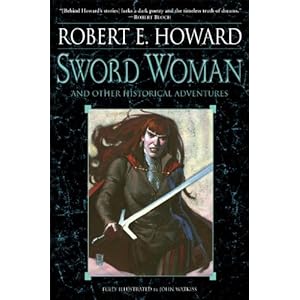
Sword Woman and Other Historical Adventures
by Robert E. Howard
Introduction by Scott Oden
Illustrations by John Watkiss

Promo copy:

The immortal legacy of Robert E. Howard, creator of Conan the Cimmerian, continues with this latest compendium of Howard’s fiction and poetry. These adventures, set in medieval-era Europe and the Near East, are among the most gripping Howard ever wrote, full of pageantry, romance, and battle scenes worthy of Tolstoy himself. Most of all, they feature some of Howard’s most unusual and memorable characters, including Cormac FitzGeoffrey, a half-Irish, half-Norman man of war who follows Richard the Lion-hearted to twelfth-century Palestine—or, as it was known to the Crusaders, Outremer; Diego de Guzman, a Spaniard who visits Cairo in the guise of a Muslim on a mission of revenge; and the legendary sword woman Dark Agnès, who, faced with an arranged marriage to a brutal husband in sixteenth-century France, cuts the ceremony short with a dagger thrust and flees to forge a new identity on the battlefield.

Lavishly illustrated by award-winning artist John Watkiss and featuring miscellanea, informative essays, and a fascinating introduction by acclaimed historical author Scott Oden, Sword Woman and Other Historical Adventures is a must-have for every fan of Robert E. Howard, who, in a career spanning just twelve years, won a place in the pantheon of great American writers.

DVDs received 1/6/11

Let’s take a quick look to see what’s arrived at the Geek Compound.

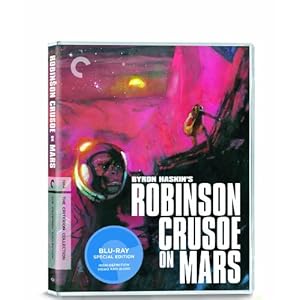
Robinson Crusoe on Mars (The Criterion Collection) [Blu-ray]

Promo copy:

Special effects wunderkind and genre master Byron Haskin (The War of the Worlds, The Outer Limits) won a place in the hearts of fantasy film lovers everywhere with this gorgeously designed journey into the unknown. Robinson Crusoe on Mars tells the story of U.S. astronaut Commander “Kit” Draper (Paul Mantee), who must fight for survival when his spaceship crash-lands on the barren waste of Mars, a pet monkey his only companion. But is he actually alone? Shot in vast Techniscope and blazing color, this is an imaginative and beloved marvel of classic science fiction.

Special Features

    Restored high-definition digital transfer, with uncompressed monaural soundtrack

    Audio commentary featuring cast and film historians

    Destination Mars, a video featurette

    Music video for Lundin’s song "Robinson Crusoe on Mars"

    Stills gallery

    Theatrical trailer

    PLUS: A booklet featuring an essay by Lennick

Sadly, I don’t own a blu ray player. (And yes, I already passed it on to an appreciative individual.)

Jack Goes Boating

Promo copy:

Jack (Academy Award winner Philip Seymour Hoffman, making his directorial debut) and Connie (Amy Ryan) are two single people who on their own might continue to recede into the anonymous background of New York City, but in each other begin to find the courage and desire to pursue a budding relationship. As Jack and Connie cautiously circle commitment, the couple that introduced them, Clyde (John Ortiz) and Lucy (Daphne Rubin-Vega), confront their own unresolved issues, and each couple comes face to face with the inevitable path of their relationship. Based on the acclaimed Off-Broadway play of the same name, this unconventional romantic comedy is a tale of love, betrayal, friendship and grace.

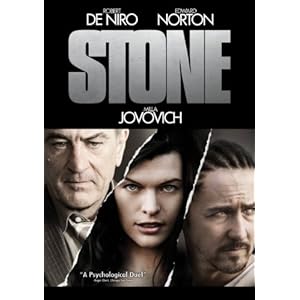
Stone

Promo copy:

Academy Award® winner Robert De Niro and Oscar® nominee Edward Norton deliver powerful performances as a seasoned corrections official and a scheming inmate whose lives become dangerously intertwined in this “gritty and engrossing thriller” (Steve O’Brien, WCBS-FM). Jack Mabry (De Niro), a parole officer days away from retirement, is asked to review the case of Gerald “Stone” Creeson (Norton), in prison for arson. Now eligible for early release, Stone needs to convince Jack he has reformed, but his attempts to influence the older man’s decision with his wife Lucetta (Milla Jovovich) have profound and unexpected effects on them both. This tale of passion, betrayal and corruption skillfully weaves together the parallel journeys of two men grappling with dark impulses, as the line between lawman and lawbreaker becomes precariously thin.

Behold the awesome power of RevSF & Brandon Zuern

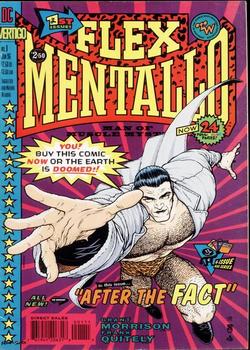
Today Vertigo announced they were finally collecting the much sought-after early Grant Morrison/Frank Quitely collaboration Flex Mentallo.

Quote:
Tuesday, January 4th, 2011

By Pamela Mullin

If you’re a fan of Grant Morrison (and who isn’t?), you’ll be stoked to know that FLEX MENTALLO will be published in book form this year. This marks the first time the four-issue mini-series written by Morrison and illustrated by artist Frank Quitely is being collected. FLEX MENTALLO sprang out of Grant’s mind bending and infamous run on DOOM PATROL.

Pick up this beautiful Deluxe Edition hardcover with bonus material this Fall.

Back in late September/early October over a glorious six day period, we (being RevolutionSF) produced
Uncanny Un-Collectibles, which outlined the comics that have never been collected (or were currently not available) but really should be. On October 1, the sixth and final day, Brandon Zuern, manager of the finest comic shop in the land, made this pronouncement.

Quote:
Flex Mentallo, Grant Morrison’s four-issue limited series about a musclebound superhero searching for other champions of justice, might not be for you. It’s too psychedelic for a mainstream audience, yet too much in love with truth, justice, and the American Way for the weirdos and freaks. It’s drug-fueled science fiction fantasy is more than the straight-laces can handle, but has a strangely sweet optimism that cynics won’t get.

But if you simply love comic books, Flex Mentallo is the mondo bizarro comics commentary you’ve been looking for.

It’s a love letter to superhero ideals laced with LSD. It’s a beautiful like an explosion, thanks to the stunning art of Frank Quitely. But because of the lead character’s similarity in look and origin to bodybuilder-turned-pitchman Charles Atlas, we may never see a collection of this amazing series. Though DC Comics stood up to the lawsuit-version of getting sand kicked in their face by Charles Atlas Co., they’ve hesitated to reprint the story. Here’s hoping Flex Mentallo uses his reality-changing mastery of Muscle Mystery to flex us up a trade paperback! It could happen, because Flex Mentallo is proof that superheroes are real. -Brandon Zuern, store manager, Austin Books & Comics

And here we are a scant three months later and Vertigo is announcing that very collection. If that doesn’t demonstrate geek power, I’m not sure what does!*

*To be fair, Brandon was far from the only person clamoring for this collection. But, this does make the second title from the feature to be collected. Not sure if someone is paying attention, but I like to think so.

Graphic Novels/Comics received 1/2/11

Let’s take a quick look to see what’s arrived at the Geek Compound.

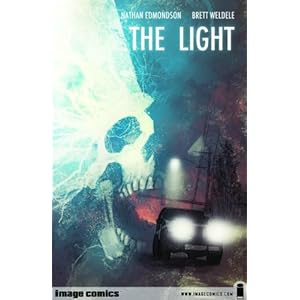
The Light
Written by Nathan Edmondson
Art by Brett Weldele

Promo copy:

It is as sudden as it is deadly. Its origins are unknown. When it strikes, a father must risk all to protect his daughter and escape across the Oregon countryside – before they are infected by THE LIGHT! Prepare yourself for the wildly acclaimed horror-thriller from writer Nathan Edmondson and artist Brett Weldele. Learn to love the darkness; learn to fear THE LIGHT! Collects THE LIGHT #1-5.

I interviewed Weldele (along with writer Robert Vendetti) about The Surrogates back in July, 2009.

Abattoir Issue #2
Created by: Darren Lynn Bousman
Concept by: Michael Peterson
Written by: Rob Levin & Troy Peteri
Illustrated by: Bing Casino

Promo copy:

Some puzzles are best left unsolved…

Time Bomb Issue 3
Created and Written by: Jimmy Palmiotti & Justin Gray
Illustrated by: Paul Gulacy
Paints by: Rain Beredo
Cover Art by: Paul Gulacy

Promo copy:

Nazis, Bombs and Babes!

Jack and WW II spy Ruth cool their heels in Metzger’s prison cell far below the surface, while the rest of the team hurries to rescue the duo and prevent the launch of the Omega Bomb. Unbeknownst to the heroes of the future, Metzger has a secret that could change the course of history as we know it. Can Jack and his team of commandos stop the Omega Bomb, defeat Metzger and escape without altering history?

Books received 1/2/11 Pyr edition

Let’s take a quick look to see what’s arrived at the Geek Compound.

Cowboy Angels
by Paul McAuley
Cover by Sparth

Promo copy:

The first Turing gate, a mere hundred nanometers across, is forced open in 1963, at the high-energy physics laboratory in Brookhaven; three years later, the first man to travel to an alternate history takes his momentous step, and an empire is born.
For fifteen years, the version of America that calls itself the Real has used its Turing gate technology to infiltrate a wide variety of alternate Americas, rebuilding those wrecked by nuclear war, fomenting revolutions and waging war to free others from communist or fascist rule, and establishing a Pan-American Alliance. Then a nation exhausted by endless strife elects Jimmy Carter on a reconstruction and reconciliation ticket, the CIA’s covert operations are wound down, and the Real begins to wage peace rather than war.

But some people believe that it is the Real’s manifest destiny to impose its idea of truth, justice, and the American way in every known alternate history, and they’re prepared to do anything to reverse Carter’s peacenik doctrine. When Adam Stone, a former CIA field officer, one of the Cowboy Angels who worked covertly in other histories, volunteers for reactivation after an old friend begins a killing spree across alternate histories, his mission uncovers a startling secret about the operation of the Turing gates and leads him into the heart of an audicious conspiracy to change the history of every America in the multiverse–including our own.

Cowboy Angels is a vivid, helter-skelter thriller in which one version of America discovers the true cost of empire building, and one man discovers that an individual really can make a difference.

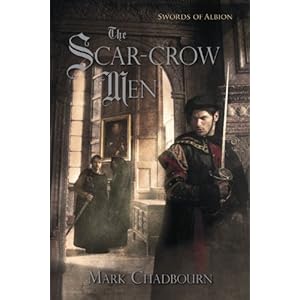
The Scar-Crow Men (Swords of the Albion)
by Mark Chadbourn
Cover by Chris McGrath

Promo copy:

The year is 1593. The London of Elizabeth I is in the terrible grip of the Black Death. As thousands die from the plague and the queen hides behind the walls of her palace, English spies are being murdered across the city. The killer’s next target: Will Swyfte.
For Swyfte–adventurer, rake, scholar, and spy–this is the darkest time he has known. His mentor, the grand old spymaster Sir Francis Walsingham, is dead. The new head of the secret service is more concerned about his own advancement than defending the nation, and a rival faction at the court has established its own network of spies. Plots are everywhere, and no one can be trusted. Meanwhile, England’s greatest enemy, the haunted Unseelie Court, prepares to make its move.

A dark, bloody scheme, years in the making, is about to be realized. The endgame begins on the night of the first performance of Dr. Faustus, the new play by Swyfte’s close friend and fellow spy Christopher Marlowe. A devil is conjured in the middle of the crowded theater, taking the form of Will Swyfte’s long-lost love, Jenny–and it has a horrifying message for him alone.

That night Marlowe is murdered, and Swyfte embarks on a personal and brutal crusade for vengeance. Friendless, with enemies on every side and a devil at his back, the spy may find that even his vaunted skills are no match for the supernatural powers arrayed against him.

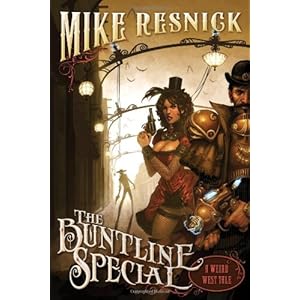
The Buntline Special
by Mike Resnick
Cover and interior illustrations by J. Seamas Gallagher

Promo copy:

The year is 1881. The United States of America ends at the Mississippi River. Beyond lies the Indian nations, where the magic of powerful Medicine Men has halted the advance of the Americans east of the river.

An American government desperate to expand its territory sends Thomas Alva Edison out West to the town of Tombstone, Arizona, on a mission to discover a scientific means of counteracting magic. Hired to protect this great genius, Wyatt Earp and his brothers.

But there are plenty who would like to see the Earps and Edison dead. Riding to their aid are old friends Doc Holliday and Bat Masterson. Against them stand the Apache wizard Geronimo and the Clanton gang. Battle lines are drawn, and the Clanton gang, which has its own reasons for wanting Edison dead, sends for Johnny Ringo, the one man who might be Doc Holliday’s equal in a gunfight. But what shows up instead is The Thing That Was Once Johnny Ringo, returned from the dead and come to Tombstone looking for a fight.

Welcome to a West like you’ve never seen before, where "Bat Masterson" hails from the ranks of the undead, where electric lights shine down on the streets of Tombstone, while horseless stagecoaches carry passengers to and fro, and where death is no obstacle to The Thing That Was Once Johnny Ringo. Think you know the story of the O.K. Corral? Think again, as five-time Hugo winner Mike Resnick takes on his first steampunk western tale, and the West will never be the same

The Past That Was

For my latest Nexus Graphica column over at SF Site, I wrote about… rather than summarize, here’s the first paragraph.

Quote:
Perhaps my favorite comment that Mark and I receive in response to our annual "Year That Was" sequences of the best graphic novels (the 2010 incarnation concluded two weeks ago) goes something likes this: "I love your selections, even though I’ve never heard of half of the books." When we started this journey in April 2008, Mark and I decided to strive for observations that stretch beyond the realms of mainstream comic book society of superheroes, fantasy, and wish fulfillment. Though we gladly cover titles from well known publishers such as DC, Dark Horse, and Image, Mark and I routinely explore the more obscure outings of the medium. In this spirit, I present this list (complied in chronological order of publication) of perhaps lesser known works that would have made the cut if we had been preparing best-of compilations when they were originally published. Sadly, half of these books are currently out of print.


Impending Geekgasm on Netflix Instant Watch – Jan edition

In 2011, Netflix continues to offer a while lot of geeky goodness. 2001, 2010, Blazing Saddles, A Clockwork Orange, Creature from the Black Lagoon, Cleopatra Jones, Farscape Seasons 1-3, The Fountain, Frankenstein Must Be Destroyed, The Kids in the Hall Seasons 1-5, The Larry Sanders Show Season 1, Naked Lunch, The Road Warrior (from a time before we realized what a complete ass Mel Gibson is), RoboCop (plus its two terrible sequels), and Smokey and the Bandit (and its complete forgettable follow up) all make their premiere or return to Instant Watch this month.

Happy viewing!

Premiering January 1:

2001: A Space Odyssey
2010: The Year We Make Contact
Above the Law
Action Jackson
The Adventures of Hajji Baba
Around the World in 80 Days (1989)
Arsenic and Old Lace
The Bad Seed
Bird of Paradise (1932)
Blazing Saddles
Child’s Play (1988)
Cleopatra Jones
A Clockwork Orange
Commando
The Craft
Creature from the Black Lagoon
The Curse of Frankenstein
Dark Portals: The Chronicles of Vidocq
Days of Darkness
Death Machine
Deathwatch
Dominion: Prequel to the Exorcist
Dracula: Dead and Loving It
Elvira, Mistress of the Dark
Farscape Seasons 1-3
Flashback (2000)
Forced Vengeance
Forever Young
The Fountain
Frankenstein Must Be Destroyed
Freejack
The Graveyard
Grim Reaper
HALO Legends
Haunted Forest
Hellbound: Hellraiser II
Hellraiser
The Hudsucker Proxy
Johnny Mnemonic
Kangaroo Jack
The Kids in the Hall Seasons 1-5
The Lady Refuses
The Larry Sanders Show Season 1
Led Zeppelin: The Song Remains the Same
The Legend of Hell House
Leprechaun 2
A Little Princess
The Lost Boys
Mars Attacks!
Naked Lunch
The Philadelphia Experiment
Pink Panther Classic Cartoon Collection
Poltergeist
The Queen of the Damned
Red Sonja
RoboCop
RoboCop 2
RoboCop 3
Romeo Must Die
The Science of Sleep
Scourge
Shaft in Africa
Shaft’s Big Score!
Spartacus: Blood and Sand
Sphere
Tank Girl
Timecop
Trick ‘r Treat
Wild Wild West
The Wizard of Oz (1939)
Wolfen

Premiering January 4:

Wizards of Waverly Place: Season 1

Premiering January 7:

Blade 2
The Disappeared
Foxy Brown
Mr. North
Seventh Moon
Smokey and the Bandit
Smokey and the Bandit II
When Time Ran Out…

Premiering January 8:

Reno 911! Season 6

Premiering January 10:

Lost Boys: The Thirst

Premiering January 21:

The Road Warrior

Premiering January 24:

Dorian Gray

Premiering January 25:

A/k/a Tommy Chong
Enter the Void
The Girl Who Kicked the Hornet’s Nest

Info courtesy of FeedFliks.

Books received 12/30/10

Let’s take a quick look to see what’s arrived at the Geek Compound.

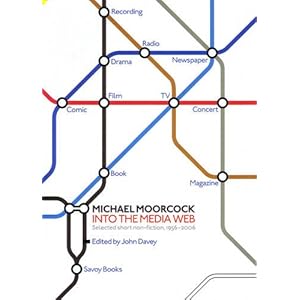
Into the Media Web: Selected short non-fiction, 1956-2006
by Michael Moorcock
Edited by John Davey
Foreword by Alan Moore
Design by John Coulhart

Promo copy:

A Brobdingnagian compendium of fifty years of Michael Moorcock’s journalism. Includes articles, editorials, fore- and afterwords, introductions, prefaces, obituaries, reviews and more. Edited by Moorcock expert and bibliographer John Davey. Foreword by Alan Moore.

Quote:
Look up the word ‘author’ in a dictionary and you’ll find a photograph of Michael Moorcock. A reluctant archetype he spans the fertile wilderness of English writing, real and living literature not to be found amidst the well-manicured parklands of the prizewinners and pundits; too tall for the shortlist. This is a web we can plunge into with complete abandon. Michael Moorcock isn’t going to steal our souls or eat us, but instead serve up a varied banquet of delights for us to pick at over a few weeks or wolf down in a single sitting. This book is a radiant and comprehensive study of one of the most important figures of our time, in all his marvellous complexity.

–Alan Moore in his foreword.

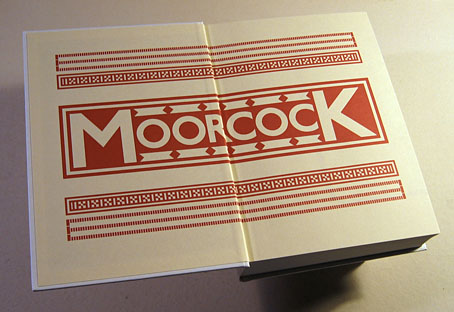
One the finest looking books I’ve encountered, this gorgeous 715 page tome collects the most significant critical/analytical pieces of Moorcock’s illustrious and varied career. Lavishly illustrated throughout, John Coulthart’s exquisite design perfectly compliments the text. Be sure to check out the visual tour of the book at Coulthart’s blog.

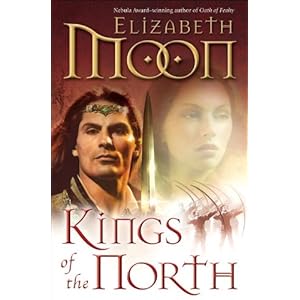
Kings of the North (Legend of Paksenarrion)
by Elizabeth Moon

Promo copy:

Elizabeth Moon returns to the fantasy world of the paladin Paksenarrion Dorthansdotter—Paks for short—in this second volume of a new series filled with all the bold imaginative flights, meticulous world-building, realistic military action, and deft characterization that readers have come to expect from this award-winning author. In Kings of the North, Moon is working at the very height of her storytelling powers.

Peace and order have been restored to the kingdoms of Tsaia and Lyonya, thanks to the crowning of two kings: Mikeli of Tsaia and, in Lyonya, Kieri Phelan, a mercenary captain whose royal blood and half-elven heritage are resented by elves and humans alike.

On the surface, all is hope and promise. But underneath, trouble is brewing. Mikeli cannot sit safely on his throne as long as remnants of the evil Verrakaien magelords are at large. Kieri is being hounded to marry and provide the kingdom with an heir—but that is the least of his concerns. A strange rift has developed between him and his grandmother and co-ruler, the immortal elven queen known as the Lady. More problematic is the ex-pirate Alured, who schemes to seize Kieri’s throne for himself—and Mikeli’s, too, while he’s at it. Meanwhile, to the north, the aggressive kingdom of Pargun seems poised to invade.

Now, as war threatens to erupt from without and within, the two kings are dangerously divided. Old alliances and the bonds of friendship are about to be tested as never before. And a shocking discovery will change everything.

Dark Waters
by Alex Prentiss
Cover by Frank Petsch

Promo copy:

By day, Rachel Matre runs a hip diner in downtown Madison, Wisconsin. By night, she slips naked into the waters of a lake whose spirits speak to her, caress her, and take her to a place of indescribable pleasure.

But now the machinations of a greedy developer have summoned another force from the depths—a strange, beautiful man with a dark agenda. Soon there is a murder by the lake. During the hunt for the killer, Rachel is pulled into a torturous limbo where all she can feel is her raging erotic lust—and never a release. A crime, an ancient curse, and a confluence of thoroughly modern relationships have plunged Rachel into the ultimate mystery: one whose solution will emerge only out of pain, desire, and a passion for the most forbidden truth of all.

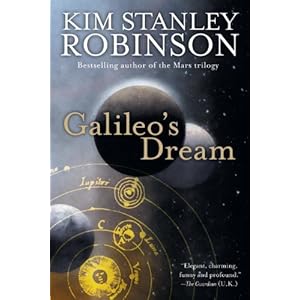
Galileo’s Dream
by Kim Stanley Robinson
Cover by Chris White

Promo copy:

At the heart of a provocative narrative that stretches from Renaissance Italy to the moons of Jupiter is the father of modern science: Galileo Galilei. To the inhabitants of the Jovian moons, Galileo is a revered figure whose actions will influence the subsequent history of the human race. From the summit of their distant future, a charismatic renegade named Ganymede travels to the past to bring Galileo forward in an attempt to alter history and ensure the ascendancy of science over religion. And if that means Galileo must be burned at the stake, so be it. From Galileo’s heresy trial to the politics of far-future Jupiter, Kim Stanley Robinson illuminates the parallels between a distant past and an even more remote future—in the process celebrating the human spirit and calling into question the convenient truths of our own moment in time.

In celebration of Michael Moorcock’s birthday Part 1

Today, December 18, is Michael Moorcock‘s birthday. In celebration of this event, I am re-publishing (in two parts) my lengthy interview with Mooorcock. The piece originally appeared as part of the defunct Scifi.com webzine Science Fiction Weekly and was reprinted in my 2003 book Geek Confidential. I’m presenting the interview as it originally appeared back in 2001.
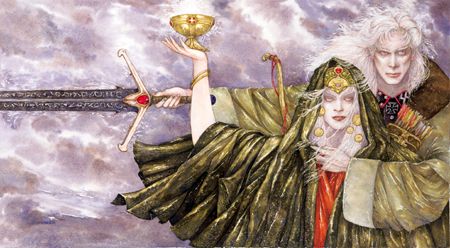

"Dreamthief’s Daughter" by Robert Gould

Michael Moorcock is one of the most prominent, prolific and popular writers in the Western world. His prodigious output includes rock songs, comics, screenplays, essays, and over seventy novels. Best known for his multiverse of interlocking heroic fantasy characters, Moorcock was recently awarded the World Fantasy Grandmaster Award For Life Achievement and is the recipient of many literary awards. Several years ago Moorcock moved from London to Lost Pines, TX, Science Fiction Weekly recently caught up with him at his home to discuss the latest Elric novel The Dreamthief’s Daughter. What we got was oh so much more.

How has the response been to The Dreamthief’s Daughter?

MOORCOCK: Oh, it’s been brilliant. So far everybody who’s read it has loved it. The weird thing about it is that every woman who’s read it, and this is really strange, has had vivid dreams as a result of reading it. Not bad dreams, just very vivid dreams.

Why do you think that is?

I have no idea. A writer never knows when he’s hit the chord. I mean, they know when they’ve done a good job, but they don’t know when they’ve hit the chord with the public. You never know that. I mean, you can think you’ve done it, and you publish it and wait for applause and the public says, “Bugger off, you sad old fool.” I mean, I thought I did that with The Final Programme, and it took about 20 years for it to get through. I thought, “Wow! They’ll love this,” and they thought, “What the hell is this?” So you never know. All I can really say is that the people who really like furry animal stories are still not going to like this any better. It’s not going to be a happy, sentimental tale of how a lot of really nice people get together to solve a problem against a lot of really, really nasty people. All the villains are nicer than the heroes.

It’s been nearly a decade since the last Elric novel, Revenge of the Rose. What made you decide to come back to Elric?

It’s a bit like a homing instinct. About once every ten years, I write a couple of Elric novels. This time I’m doing three. I seem to get fresh ideas for Elric novels about once every decade. It’s as simple as that. To some extent, the ideas for these novels came out of working on the comic [Michael Moorcock’s Multiverse]. You know, doing an Elric story for the multiverse comic and thinking about that and sort of locking that in to real historical periods, I realized that I could develop that a bit. And so, in a sense, a lot of my recent stuff, you can find a sort of template for it in that multiverse comic. It’s where I tried out a lot of ideas.

So you would suggest the Multiverse comic for your fans, then?

Well, not really, no. They’re completely baffled by it. But from my point of view, it’s a kind of seedbed where a lot of the other stuff has been coming out of. And certainly you can look back to the Elric story in the Multiverse comic and see some of the ideas that are beginning to…Also, in Tales From the Texas Woods there’s a kind of an Elric story which refers to the same underground world and so I developed some of those ideas further. In a way, it’s bringing together a number of ideas I’ve been working on, knocking around for some years


Art by Walter Simonson

Why do you think it’s Elric that you keep coming back to, as opposed to your other fantasy characters?

Elric simply does work on more levels than any of the other characters. When you think about it, there’s more Elric figurines, more Elric comics, more Elric product. And when you look at Amazon, it’s all Elric. The best-selling books of mine are all Elric books. So clearly there’s a lot, you know. He’s certainly a character I identify with much more closely that any of the others, personally. I really do. And no matter how many people say, “I prefer Corum,” or, “I really prefer Hawkwind,” I always think, “Well, they’re all right, but here’s my best lad. Here’s Elric.” And Jerry Cornelius is really a version of Elric more than he is a version of Corum or anyone else. So again, Elric is really one of the dominant figures in the whole thing. Someone asked me about Elric, and I said, you know, in a way he’s Pierrot. A romantic, tragic but, from another viewpoint, a comic figure. In Commedia D’ell Arte, Pierrot is essentially someone who’s constantly striving for something and constantly failing, so that’s why your sympathies are with him. A failed trickster. On one level that’s what Jerry Cornelius is, and that’s what Elric is, i.e., their failures are magnificent. What that says, what that’s constantly saying to the reader is that it is worth striving to do things, but there’s a price you pay for things. There’s always a price, and my characters always have to pay a price. They don’t come home in the end and everybody gets a piece of cake, a nice cup of tea and they all say, “Hooray, hooray, we’ve saved the day. The rings are all back in the box or whatever and we’re a finer, wiser, and happier people since saving the world from this terrible evil of people who speak with funny, bellowing voices and thus immediately identify themselves as baddies.”

Why do you think Elric has remained popular for almost 40 years?

I think that he is probably, of all of my fantasy heroes, all of my epic heroes, he’s the one who most embodies my own ideas, my own struggles, my own sort of psyche…my own moral questions and that sort of thing. And he remains a very modern, existential sort of hero. He can quite easily develop as I develop. There’s still plenty of development in Elric’s character, because he’s set up right. He’s already asking the questions, he’s already dealing with the problems. It’s odd, really. I don’t know of very much work of this particular kind that does that, except for science fiction. Science fiction, oddly enough, does a lot more of what I tend to do in fantasy. I’ve noticed I don’t read a lot of fantasy—I never did. I just started writing it. I just happened to have the facility. Pretty much all the other stuff in that form has been published since I started writing it. So I’m not particularly interested in it as a genre. I didn’t start writing it because there was a big genre out there to write into. There was me and Tolkien. Basically, at the beginning, me and Tolkien were selling about the same, which was very very few. Tolkien was regarded as just another writer like [Mervyn] Peake who had an enthusiastic following, but wasn’t in any way mainstream or likely to take off. In a sense, I started writing Elric as much in contrast to Tolkien as I was writing it in contrast to Conan. I didn’t like Tolkien because it had a fairy story quality. It didn’t have what I would regard as a properly tragic quality. It was too sentimental for my taste. I’m attracted to lyrical, romantic, tragic kind of stuff, rather than the 5 people solve a problem together, which is essentially the Tolkien formula. It’s the formula which most people prefer. It’s the one that goes into RPG games and stuff like that. I’m writing about alienated individuals who are fundamentally solitary, who don’t really want do an awful lot with other people. And again, it’s my own experience. I pretty much brought myself up, and I pretty much looked after myself in my own feet from a very early age. I was earning my own living from the age of 15. I don’t think in terms of five friends getting together to solve a problem.

How is producing an Elric novel now different than it was back in the 60’s?

Well, it’s no different in one sense, and that is it’s just as hard. And the reason is because I deliberately make it harder for myself. I don’t make it harder for the audience—that’s not the idea. The idea is to write a book that the audience is going to buy. I mean, these books are also written for money. I’m not trying to put off people, but at the same time, obviously I can’t make compromises. I just have to write what I write. But at the same time, my idea is not to put obstacles in the way of somebody buying it. I’m not going to make it a difficult read. What I’m going to do is make it a difficult write. I’m going to give myself new tasks that I haven’t solved before. I’ve said this about rock and roll before, the thing that gives great rock and roll its quality is that it’s always not quite sure where it’s going. It’s never quite sure it’s going to get there, you know? And everything: voice, instrument, everything, the great rock and roll is just on the edge of… it’s always just expanding itself. Essentially, I was winging it with Stormbringer. I was sort of riding a very fast motorbike but didn’t know quite where it was going. I just hoped to God I could hold on and keep steering over the bumpy bits. So you need to set another standard, a higher standard, that doesn’t interfere with the reader’s enjoyment of the narrative or stop them from getting any pleasure from the book they would normally get. They don’t need to know what you’re doing, but you have to do it for yourself. And the other analogy is essentially how you get a good rock and roll voice on stage. If you raise the mike up above the level of your head, you’re straining to reach the mike and in that act of straining to reach it, you introduce tensions, which are, again, essentially the tensions that are in rock and roll. That’s why operatic voices can’t sing rock and roll—trained voices can’t sing certain songs that untrained voices sing better, i.e., Pavarotti singing a Willie Nelson song is crazy, and yet Willie Nelson could probably just about sing any Pavarotti song and it wouldn’t sound crazy, because he would modify his mouth rather than his diaphragm to change notes and things like that. He would just sing it. He would have found a way of singing it, and that’s one of the things that’s interesting. That what attracts you to science fiction and rock and roll initially, what attracted me, was the fact that they were raw, they were new, and that they hadn’t been taken over by anybody. There weren’t any magazines, websites, and so forth to make me feel self-conscious. That was the ambience in which you wrote and produced. You’ve got to reproduce that in some way. And what I’ve done is I’ve made the narrative harder for me to write, but I know it isn’t harder for anybody to read, because everybody that’s read it has said, ”Great,” you know—zipped through it. So I know that that works. But what I did, what I had to do in order to achieve that was something more difficult than I’ve done previously. What a long answer.
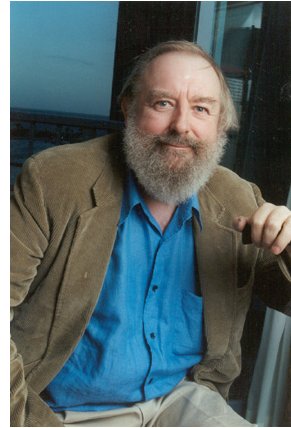

Photo by Charles N. Brown

It seems like in the last 10 years or so you’ve made a conscious effort to make the multiverse a smaller place—to have the characters inter-relate more.

Well, yeah, to some extent that’s true. But what I’ve also been doing is expanding. It goes both ways. And really, partly, it’s chaos theory. The more I’ve understood chaos theory as such, and I don’t mean this kind of fashionable stuff they call chaos theory, but the actual mathematics involved in Mandelbrot, the more I’ve understood that, the more rational the irrational world becomes. I’ve been able to produce a much more coherent, as it were, version of the multiverse. And it’s almost like there are zones in it now, whereas there weren’t before. Again, it goes back to the comic and War Amongst the Angels, which has Elric in it as well. But the other thing I discovered I could do through writing those books, and this is very deliberate, how to write a story about the same character, one story could be just straight realistic, set in Austin, say, and absolutely no element of fantasy in it at all, and the next story be about the same characters but completely fantastic. Because for me, both things are true, i.e., my imaginative life and my real life are as vivid as each other. I want to describe that experience in a story without having to rationalize it or explain it in any kind of generic way except by my own logic, my own rationale. What you’re looking at in my fiction, is not so much generic work as such, but individual work that is in a sense its own genre, attempting to solve its own generic problems. The genre developed after I had started.

When you say, “its own genre,” just like fantasy and science fiction have their own set of rules within the genre, does it have its own set of rules?

Yes, that’s right. That you have to follow to fulfill reader’s expectations. To give the customer what they want. My readers have certain expectations of me. Any new reader can come into my multiverse with any new book and not feel they’ve got to read all the other books. But that is exactly the same as you read your first novel about real life, you don’t feel you’ve got to know everything about the real world. You only need to know about the real world of that book. In To Kill A Mockingbird, you need to know what’s going on in that town with those people and so forth. You don’t think, “Oh my God! I can’t read To Kill A Mockingbird until I have read the entire history of the south,” and etc., etc.,–you just don’t do that. So I don’t want readers to be put off by seeing that kind of coherent body of work and thinking, “God, where do I start out, and where do I finish?” What I offer is the same as what maybe a movie director offers: if you fancy this aspect of my work, this aspect of my life, then go for that. I don’t expect you to like Elric and Pyat. I’m very glad when you do, but I don’t expect you to. One of the things I said to Betsy Mitchell [editor of The Dreamthief’s Daughter] before I even began these was, “I want you to know if you have never read an Elric book and your reps have never read an Elric book and your editorial people and your advertising people have never read an Elric book, it doesn’t matter. This is going to be a book that you will never have to read another Moorcock title to enjoy.” I’m offering a broad range of entertainment here. I’m like a TV channel.

Are you waiting for the Moorcock section at the bookstores?

I used to be the Moorcock section, and this is unfortunate. The bookstores used to have a Moorcock section. That was in my heyday, before all these other f—–s came along. But at one point, it was just Tolkien, and he didn’t really have a section as such, and then there was me. And it’s absolutely true, everybody said this at the time, I was a category. I was sold as a category. I was sold, essentially, to the distributors as a category: “How many Moorcock’s do you want this month?” Since then there have been some fine new books and an awful lot of bad xeroxes, but I’ve never been out of print anywhere in the world, really. I mean, 40 years and I’ve stayed in print—that’s not bad. And most of them are readable. The other thing I’m proud of, and again, people say this and I feel it’s true, but obviously I can’t propose it myself — my books don’t actually go off in quality. Again, it’s a question of personal pride. I couldn’t do anything but my best. Just because you produce a nice line of furniture that’s very good and lasts and everybody says, “Oh, I’ll buy Moorcock furniture,” you don’t immediately cut the quality down so that people fall down and their tables fall apart. I feel that special relationship that I have with the reader. My deal with the reader is that I deliver the best quality I possibly can. Furniture you can use. That does the job it’s supposed to do. I mean, there’s a chance I’ll get senile and lose this ability, but while I’m not, that’s what I do. It’s an old-fashioned family business which takes pride in what it produces!

More in Part 2