Graphic Novels/Comics received 1/2/11

Let’s take a quick look to see what’s arrived at the Geek Compound.

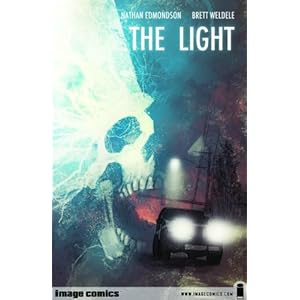
The Light
Written by Nathan Edmondson
Art by Brett Weldele

Promo copy:

It is as sudden as it is deadly. Its origins are unknown. When it strikes, a father must risk all to protect his daughter and escape across the Oregon countryside – before they are infected by THE LIGHT! Prepare yourself for the wildly acclaimed horror-thriller from writer Nathan Edmondson and artist Brett Weldele. Learn to love the darkness; learn to fear THE LIGHT! Collects THE LIGHT #1-5.

I interviewed Weldele (along with writer Robert Vendetti) about The Surrogates back in July, 2009.

Abattoir Issue #2
Created by: Darren Lynn Bousman
Concept by: Michael Peterson
Written by: Rob Levin & Troy Peteri
Illustrated by: Bing Casino

Promo copy:

Some puzzles are best left unsolved…

Time Bomb Issue 3
Created and Written by: Jimmy Palmiotti & Justin Gray
Illustrated by: Paul Gulacy
Paints by: Rain Beredo
Cover Art by: Paul Gulacy

Promo copy:

Nazis, Bombs and Babes!

Jack and WW II spy Ruth cool their heels in Metzger’s prison cell far below the surface, while the rest of the team hurries to rescue the duo and prevent the launch of the Omega Bomb. Unbeknownst to the heroes of the future, Metzger has a secret that could change the course of history as we know it. Can Jack and his team of commandos stop the Omega Bomb, defeat Metzger and escape without altering history?

Books received 1/2/11 Pyr edition

Let’s take a quick look to see what’s arrived at the Geek Compound.

Cowboy Angels
by Paul McAuley
Cover by Sparth

Promo copy:

The first Turing gate, a mere hundred nanometers across, is forced open in 1963, at the high-energy physics laboratory in Brookhaven; three years later, the first man to travel to an alternate history takes his momentous step, and an empire is born.
For fifteen years, the version of America that calls itself the Real has used its Turing gate technology to infiltrate a wide variety of alternate Americas, rebuilding those wrecked by nuclear war, fomenting revolutions and waging war to free others from communist or fascist rule, and establishing a Pan-American Alliance. Then a nation exhausted by endless strife elects Jimmy Carter on a reconstruction and reconciliation ticket, the CIA’s covert operations are wound down, and the Real begins to wage peace rather than war.

But some people believe that it is the Real’s manifest destiny to impose its idea of truth, justice, and the American way in every known alternate history, and they’re prepared to do anything to reverse Carter’s peacenik doctrine. When Adam Stone, a former CIA field officer, one of the Cowboy Angels who worked covertly in other histories, volunteers for reactivation after an old friend begins a killing spree across alternate histories, his mission uncovers a startling secret about the operation of the Turing gates and leads him into the heart of an audicious conspiracy to change the history of every America in the multiverse–including our own.

Cowboy Angels is a vivid, helter-skelter thriller in which one version of America discovers the true cost of empire building, and one man discovers that an individual really can make a difference.

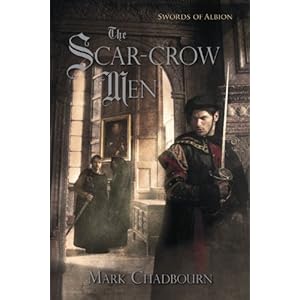
The Scar-Crow Men (Swords of the Albion)
by Mark Chadbourn
Cover by Chris McGrath

Promo copy:

The year is 1593. The London of Elizabeth I is in the terrible grip of the Black Death. As thousands die from the plague and the queen hides behind the walls of her palace, English spies are being murdered across the city. The killer’s next target: Will Swyfte.
For Swyfte–adventurer, rake, scholar, and spy–this is the darkest time he has known. His mentor, the grand old spymaster Sir Francis Walsingham, is dead. The new head of the secret service is more concerned about his own advancement than defending the nation, and a rival faction at the court has established its own network of spies. Plots are everywhere, and no one can be trusted. Meanwhile, England’s greatest enemy, the haunted Unseelie Court, prepares to make its move.

A dark, bloody scheme, years in the making, is about to be realized. The endgame begins on the night of the first performance of Dr. Faustus, the new play by Swyfte’s close friend and fellow spy Christopher Marlowe. A devil is conjured in the middle of the crowded theater, taking the form of Will Swyfte’s long-lost love, Jenny–and it has a horrifying message for him alone.

That night Marlowe is murdered, and Swyfte embarks on a personal and brutal crusade for vengeance. Friendless, with enemies on every side and a devil at his back, the spy may find that even his vaunted skills are no match for the supernatural powers arrayed against him.

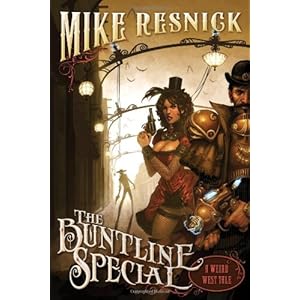
The Buntline Special
by Mike Resnick
Cover and interior illustrations by J. Seamas Gallagher

Promo copy:

The year is 1881. The United States of America ends at the Mississippi River. Beyond lies the Indian nations, where the magic of powerful Medicine Men has halted the advance of the Americans east of the river.

An American government desperate to expand its territory sends Thomas Alva Edison out West to the town of Tombstone, Arizona, on a mission to discover a scientific means of counteracting magic. Hired to protect this great genius, Wyatt Earp and his brothers.

But there are plenty who would like to see the Earps and Edison dead. Riding to their aid are old friends Doc Holliday and Bat Masterson. Against them stand the Apache wizard Geronimo and the Clanton gang. Battle lines are drawn, and the Clanton gang, which has its own reasons for wanting Edison dead, sends for Johnny Ringo, the one man who might be Doc Holliday’s equal in a gunfight. But what shows up instead is The Thing That Was Once Johnny Ringo, returned from the dead and come to Tombstone looking for a fight.

Welcome to a West like you’ve never seen before, where "Bat Masterson" hails from the ranks of the undead, where electric lights shine down on the streets of Tombstone, while horseless stagecoaches carry passengers to and fro, and where death is no obstacle to The Thing That Was Once Johnny Ringo. Think you know the story of the O.K. Corral? Think again, as five-time Hugo winner Mike Resnick takes on his first steampunk western tale, and the West will never be the same

The Past That Was

For my latest Nexus Graphica column over at SF Site, I wrote about… rather than summarize, here’s the first paragraph.

Quote:
Perhaps my favorite comment that Mark and I receive in response to our annual "Year That Was" sequences of the best graphic novels (the 2010 incarnation concluded two weeks ago) goes something likes this: "I love your selections, even though I’ve never heard of half of the books." When we started this journey in April 2008, Mark and I decided to strive for observations that stretch beyond the realms of mainstream comic book society of superheroes, fantasy, and wish fulfillment. Though we gladly cover titles from well known publishers such as DC, Dark Horse, and Image, Mark and I routinely explore the more obscure outings of the medium. In this spirit, I present this list (complied in chronological order of publication) of perhaps lesser known works that would have made the cut if we had been preparing best-of compilations when they were originally published. Sadly, half of these books are currently out of print.


Impending Geekgasm on Netflix Instant Watch – Jan edition

In 2011, Netflix continues to offer a while lot of geeky goodness. 2001, 2010, Blazing Saddles, A Clockwork Orange, Creature from the Black Lagoon, Cleopatra Jones, Farscape Seasons 1-3, The Fountain, Frankenstein Must Be Destroyed, The Kids in the Hall Seasons 1-5, The Larry Sanders Show Season 1, Naked Lunch, The Road Warrior (from a time before we realized what a complete ass Mel Gibson is), RoboCop (plus its two terrible sequels), and Smokey and the Bandit (and its complete forgettable follow up) all make their premiere or return to Instant Watch this month.

Happy viewing!

Premiering January 1:

2001: A Space Odyssey
2010: The Year We Make Contact
Above the Law
Action Jackson
The Adventures of Hajji Baba
Around the World in 80 Days (1989)
Arsenic and Old Lace
The Bad Seed
Bird of Paradise (1932)
Blazing Saddles
Child’s Play (1988)
Cleopatra Jones
A Clockwork Orange
Commando
The Craft
Creature from the Black Lagoon
The Curse of Frankenstein
Dark Portals: The Chronicles of Vidocq
Days of Darkness
Death Machine
Deathwatch
Dominion: Prequel to the Exorcist
Dracula: Dead and Loving It
Elvira, Mistress of the Dark
Farscape Seasons 1-3
Flashback (2000)
Forced Vengeance
Forever Young
The Fountain
Frankenstein Must Be Destroyed
Freejack
The Graveyard
Grim Reaper
HALO Legends
Haunted Forest
Hellbound: Hellraiser II
Hellraiser
The Hudsucker Proxy
Johnny Mnemonic
Kangaroo Jack
The Kids in the Hall Seasons 1-5
The Lady Refuses
The Larry Sanders Show Season 1
Led Zeppelin: The Song Remains the Same
The Legend of Hell House
Leprechaun 2
A Little Princess
The Lost Boys
Mars Attacks!
Naked Lunch
The Philadelphia Experiment
Pink Panther Classic Cartoon Collection
Poltergeist
The Queen of the Damned
Red Sonja
RoboCop
RoboCop 2
RoboCop 3
Romeo Must Die
The Science of Sleep
Scourge
Shaft in Africa
Shaft’s Big Score!
Spartacus: Blood and Sand
Sphere
Tank Girl
Timecop
Trick ‘r Treat
Wild Wild West
The Wizard of Oz (1939)
Wolfen

Premiering January 4:

Wizards of Waverly Place: Season 1

Premiering January 7:

Blade 2
The Disappeared
Foxy Brown
Mr. North
Seventh Moon
Smokey and the Bandit
Smokey and the Bandit II
When Time Ran Out…

Premiering January 8:

Reno 911! Season 6

Premiering January 10:

Lost Boys: The Thirst

Premiering January 21:

The Road Warrior

Premiering January 24:

Dorian Gray

Premiering January 25:

A/k/a Tommy Chong
Enter the Void
The Girl Who Kicked the Hornet’s Nest

Info courtesy of FeedFliks.

Books received 12/30/10

Let’s take a quick look to see what’s arrived at the Geek Compound.

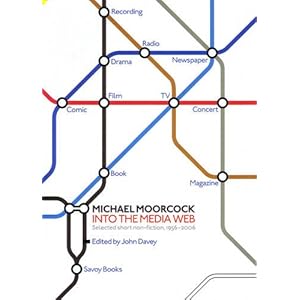
Into the Media Web: Selected short non-fiction, 1956-2006
by Michael Moorcock
Edited by John Davey
Foreword by Alan Moore
Design by John Coulhart

Promo copy:

A Brobdingnagian compendium of fifty years of Michael Moorcock’s journalism. Includes articles, editorials, fore- and afterwords, introductions, prefaces, obituaries, reviews and more. Edited by Moorcock expert and bibliographer John Davey. Foreword by Alan Moore.

Quote:
Look up the word ‘author’ in a dictionary and you’ll find a photograph of Michael Moorcock. A reluctant archetype he spans the fertile wilderness of English writing, real and living literature not to be found amidst the well-manicured parklands of the prizewinners and pundits; too tall for the shortlist. This is a web we can plunge into with complete abandon. Michael Moorcock isn’t going to steal our souls or eat us, but instead serve up a varied banquet of delights for us to pick at over a few weeks or wolf down in a single sitting. This book is a radiant and comprehensive study of one of the most important figures of our time, in all his marvellous complexity.

–Alan Moore in his foreword.

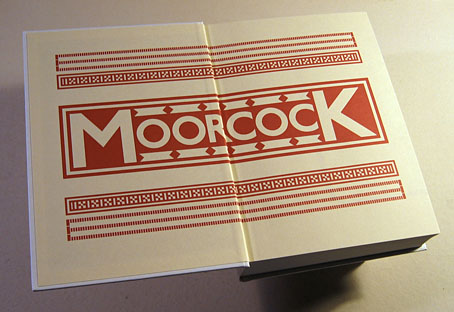
One the finest looking books I’ve encountered, this gorgeous 715 page tome collects the most significant critical/analytical pieces of Moorcock’s illustrious and varied career. Lavishly illustrated throughout, John Coulthart’s exquisite design perfectly compliments the text. Be sure to check out the visual tour of the book at Coulthart’s blog.

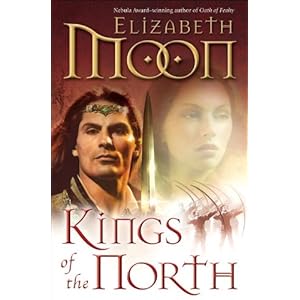
Kings of the North (Legend of Paksenarrion)
by Elizabeth Moon

Promo copy:

Elizabeth Moon returns to the fantasy world of the paladin Paksenarrion Dorthansdotter—Paks for short—in this second volume of a new series filled with all the bold imaginative flights, meticulous world-building, realistic military action, and deft characterization that readers have come to expect from this award-winning author. In Kings of the North, Moon is working at the very height of her storytelling powers.

Peace and order have been restored to the kingdoms of Tsaia and Lyonya, thanks to the crowning of two kings: Mikeli of Tsaia and, in Lyonya, Kieri Phelan, a mercenary captain whose royal blood and half-elven heritage are resented by elves and humans alike.

On the surface, all is hope and promise. But underneath, trouble is brewing. Mikeli cannot sit safely on his throne as long as remnants of the evil Verrakaien magelords are at large. Kieri is being hounded to marry and provide the kingdom with an heir—but that is the least of his concerns. A strange rift has developed between him and his grandmother and co-ruler, the immortal elven queen known as the Lady. More problematic is the ex-pirate Alured, who schemes to seize Kieri’s throne for himself—and Mikeli’s, too, while he’s at it. Meanwhile, to the north, the aggressive kingdom of Pargun seems poised to invade.

Now, as war threatens to erupt from without and within, the two kings are dangerously divided. Old alliances and the bonds of friendship are about to be tested as never before. And a shocking discovery will change everything.

Dark Waters
by Alex Prentiss
Cover by Frank Petsch

Promo copy:

By day, Rachel Matre runs a hip diner in downtown Madison, Wisconsin. By night, she slips naked into the waters of a lake whose spirits speak to her, caress her, and take her to a place of indescribable pleasure.

But now the machinations of a greedy developer have summoned another force from the depths—a strange, beautiful man with a dark agenda. Soon there is a murder by the lake. During the hunt for the killer, Rachel is pulled into a torturous limbo where all she can feel is her raging erotic lust—and never a release. A crime, an ancient curse, and a confluence of thoroughly modern relationships have plunged Rachel into the ultimate mystery: one whose solution will emerge only out of pain, desire, and a passion for the most forbidden truth of all.

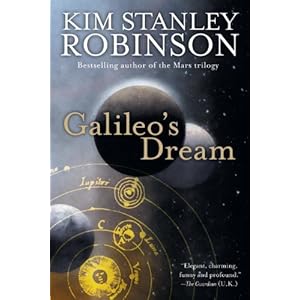
Galileo’s Dream
by Kim Stanley Robinson
Cover by Chris White

Promo copy:

At the heart of a provocative narrative that stretches from Renaissance Italy to the moons of Jupiter is the father of modern science: Galileo Galilei. To the inhabitants of the Jovian moons, Galileo is a revered figure whose actions will influence the subsequent history of the human race. From the summit of their distant future, a charismatic renegade named Ganymede travels to the past to bring Galileo forward in an attempt to alter history and ensure the ascendancy of science over religion. And if that means Galileo must be burned at the stake, so be it. From Galileo’s heresy trial to the politics of far-future Jupiter, Kim Stanley Robinson illuminates the parallels between a distant past and an even more remote future—in the process celebrating the human spirit and calling into question the convenient truths of our own moment in time.

In celebration of Michael Moorcock’s birthday Part 1

Today, December 18, is Michael Moorcock‘s birthday. In celebration of this event, I am re-publishing (in two parts) my lengthy interview with Mooorcock. The piece originally appeared as part of the defunct Scifi.com webzine Science Fiction Weekly and was reprinted in my 2003 book Geek Confidential. I’m presenting the interview as it originally appeared back in 2001.
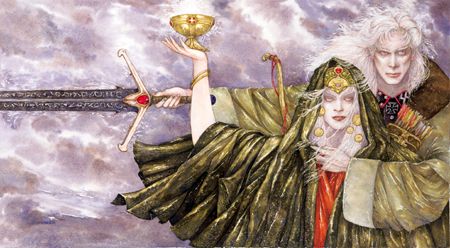

"Dreamthief’s Daughter" by Robert Gould

Michael Moorcock is one of the most prominent, prolific and popular writers in the Western world. His prodigious output includes rock songs, comics, screenplays, essays, and over seventy novels. Best known for his multiverse of interlocking heroic fantasy characters, Moorcock was recently awarded the World Fantasy Grandmaster Award For Life Achievement and is the recipient of many literary awards. Several years ago Moorcock moved from London to Lost Pines, TX, Science Fiction Weekly recently caught up with him at his home to discuss the latest Elric novel The Dreamthief’s Daughter. What we got was oh so much more.

How has the response been to The Dreamthief’s Daughter?

MOORCOCK: Oh, it’s been brilliant. So far everybody who’s read it has loved it. The weird thing about it is that every woman who’s read it, and this is really strange, has had vivid dreams as a result of reading it. Not bad dreams, just very vivid dreams.

Why do you think that is?

I have no idea. A writer never knows when he’s hit the chord. I mean, they know when they’ve done a good job, but they don’t know when they’ve hit the chord with the public. You never know that. I mean, you can think you’ve done it, and you publish it and wait for applause and the public says, “Bugger off, you sad old fool.” I mean, I thought I did that with The Final Programme, and it took about 20 years for it to get through. I thought, “Wow! They’ll love this,” and they thought, “What the hell is this?” So you never know. All I can really say is that the people who really like furry animal stories are still not going to like this any better. It’s not going to be a happy, sentimental tale of how a lot of really nice people get together to solve a problem against a lot of really, really nasty people. All the villains are nicer than the heroes.

It’s been nearly a decade since the last Elric novel, Revenge of the Rose. What made you decide to come back to Elric?

It’s a bit like a homing instinct. About once every ten years, I write a couple of Elric novels. This time I’m doing three. I seem to get fresh ideas for Elric novels about once every decade. It’s as simple as that. To some extent, the ideas for these novels came out of working on the comic [Michael Moorcock’s Multiverse]. You know, doing an Elric story for the multiverse comic and thinking about that and sort of locking that in to real historical periods, I realized that I could develop that a bit. And so, in a sense, a lot of my recent stuff, you can find a sort of template for it in that multiverse comic. It’s where I tried out a lot of ideas.

So you would suggest the Multiverse comic for your fans, then?

Well, not really, no. They’re completely baffled by it. But from my point of view, it’s a kind of seedbed where a lot of the other stuff has been coming out of. And certainly you can look back to the Elric story in the Multiverse comic and see some of the ideas that are beginning to…Also, in Tales From the Texas Woods there’s a kind of an Elric story which refers to the same underground world and so I developed some of those ideas further. In a way, it’s bringing together a number of ideas I’ve been working on, knocking around for some years


Art by Walter Simonson

Why do you think it’s Elric that you keep coming back to, as opposed to your other fantasy characters?

Elric simply does work on more levels than any of the other characters. When you think about it, there’s more Elric figurines, more Elric comics, more Elric product. And when you look at Amazon, it’s all Elric. The best-selling books of mine are all Elric books. So clearly there’s a lot, you know. He’s certainly a character I identify with much more closely that any of the others, personally. I really do. And no matter how many people say, “I prefer Corum,” or, “I really prefer Hawkwind,” I always think, “Well, they’re all right, but here’s my best lad. Here’s Elric.” And Jerry Cornelius is really a version of Elric more than he is a version of Corum or anyone else. So again, Elric is really one of the dominant figures in the whole thing. Someone asked me about Elric, and I said, you know, in a way he’s Pierrot. A romantic, tragic but, from another viewpoint, a comic figure. In Commedia D’ell Arte, Pierrot is essentially someone who’s constantly striving for something and constantly failing, so that’s why your sympathies are with him. A failed trickster. On one level that’s what Jerry Cornelius is, and that’s what Elric is, i.e., their failures are magnificent. What that says, what that’s constantly saying to the reader is that it is worth striving to do things, but there’s a price you pay for things. There’s always a price, and my characters always have to pay a price. They don’t come home in the end and everybody gets a piece of cake, a nice cup of tea and they all say, “Hooray, hooray, we’ve saved the day. The rings are all back in the box or whatever and we’re a finer, wiser, and happier people since saving the world from this terrible evil of people who speak with funny, bellowing voices and thus immediately identify themselves as baddies.”

Why do you think Elric has remained popular for almost 40 years?

I think that he is probably, of all of my fantasy heroes, all of my epic heroes, he’s the one who most embodies my own ideas, my own struggles, my own sort of psyche…my own moral questions and that sort of thing. And he remains a very modern, existential sort of hero. He can quite easily develop as I develop. There’s still plenty of development in Elric’s character, because he’s set up right. He’s already asking the questions, he’s already dealing with the problems. It’s odd, really. I don’t know of very much work of this particular kind that does that, except for science fiction. Science fiction, oddly enough, does a lot more of what I tend to do in fantasy. I’ve noticed I don’t read a lot of fantasy—I never did. I just started writing it. I just happened to have the facility. Pretty much all the other stuff in that form has been published since I started writing it. So I’m not particularly interested in it as a genre. I didn’t start writing it because there was a big genre out there to write into. There was me and Tolkien. Basically, at the beginning, me and Tolkien were selling about the same, which was very very few. Tolkien was regarded as just another writer like [Mervyn] Peake who had an enthusiastic following, but wasn’t in any way mainstream or likely to take off. In a sense, I started writing Elric as much in contrast to Tolkien as I was writing it in contrast to Conan. I didn’t like Tolkien because it had a fairy story quality. It didn’t have what I would regard as a properly tragic quality. It was too sentimental for my taste. I’m attracted to lyrical, romantic, tragic kind of stuff, rather than the 5 people solve a problem together, which is essentially the Tolkien formula. It’s the formula which most people prefer. It’s the one that goes into RPG games and stuff like that. I’m writing about alienated individuals who are fundamentally solitary, who don’t really want do an awful lot with other people. And again, it’s my own experience. I pretty much brought myself up, and I pretty much looked after myself in my own feet from a very early age. I was earning my own living from the age of 15. I don’t think in terms of five friends getting together to solve a problem.

How is producing an Elric novel now different than it was back in the 60’s?

Well, it’s no different in one sense, and that is it’s just as hard. And the reason is because I deliberately make it harder for myself. I don’t make it harder for the audience—that’s not the idea. The idea is to write a book that the audience is going to buy. I mean, these books are also written for money. I’m not trying to put off people, but at the same time, obviously I can’t make compromises. I just have to write what I write. But at the same time, my idea is not to put obstacles in the way of somebody buying it. I’m not going to make it a difficult read. What I’m going to do is make it a difficult write. I’m going to give myself new tasks that I haven’t solved before. I’ve said this about rock and roll before, the thing that gives great rock and roll its quality is that it’s always not quite sure where it’s going. It’s never quite sure it’s going to get there, you know? And everything: voice, instrument, everything, the great rock and roll is just on the edge of… it’s always just expanding itself. Essentially, I was winging it with Stormbringer. I was sort of riding a very fast motorbike but didn’t know quite where it was going. I just hoped to God I could hold on and keep steering over the bumpy bits. So you need to set another standard, a higher standard, that doesn’t interfere with the reader’s enjoyment of the narrative or stop them from getting any pleasure from the book they would normally get. They don’t need to know what you’re doing, but you have to do it for yourself. And the other analogy is essentially how you get a good rock and roll voice on stage. If you raise the mike up above the level of your head, you’re straining to reach the mike and in that act of straining to reach it, you introduce tensions, which are, again, essentially the tensions that are in rock and roll. That’s why operatic voices can’t sing rock and roll—trained voices can’t sing certain songs that untrained voices sing better, i.e., Pavarotti singing a Willie Nelson song is crazy, and yet Willie Nelson could probably just about sing any Pavarotti song and it wouldn’t sound crazy, because he would modify his mouth rather than his diaphragm to change notes and things like that. He would just sing it. He would have found a way of singing it, and that’s one of the things that’s interesting. That what attracts you to science fiction and rock and roll initially, what attracted me, was the fact that they were raw, they were new, and that they hadn’t been taken over by anybody. There weren’t any magazines, websites, and so forth to make me feel self-conscious. That was the ambience in which you wrote and produced. You’ve got to reproduce that in some way. And what I’ve done is I’ve made the narrative harder for me to write, but I know it isn’t harder for anybody to read, because everybody that’s read it has said, ”Great,” you know—zipped through it. So I know that that works. But what I did, what I had to do in order to achieve that was something more difficult than I’ve done previously. What a long answer.
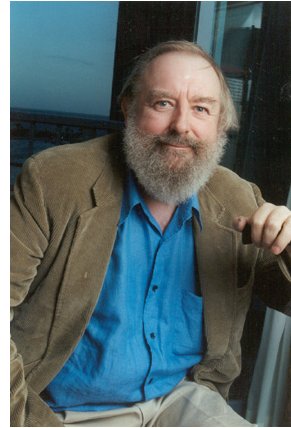

Photo by Charles N. Brown

It seems like in the last 10 years or so you’ve made a conscious effort to make the multiverse a smaller place—to have the characters inter-relate more.

Well, yeah, to some extent that’s true. But what I’ve also been doing is expanding. It goes both ways. And really, partly, it’s chaos theory. The more I’ve understood chaos theory as such, and I don’t mean this kind of fashionable stuff they call chaos theory, but the actual mathematics involved in Mandelbrot, the more I’ve understood that, the more rational the irrational world becomes. I’ve been able to produce a much more coherent, as it were, version of the multiverse. And it’s almost like there are zones in it now, whereas there weren’t before. Again, it goes back to the comic and War Amongst the Angels, which has Elric in it as well. But the other thing I discovered I could do through writing those books, and this is very deliberate, how to write a story about the same character, one story could be just straight realistic, set in Austin, say, and absolutely no element of fantasy in it at all, and the next story be about the same characters but completely fantastic. Because for me, both things are true, i.e., my imaginative life and my real life are as vivid as each other. I want to describe that experience in a story without having to rationalize it or explain it in any kind of generic way except by my own logic, my own rationale. What you’re looking at in my fiction, is not so much generic work as such, but individual work that is in a sense its own genre, attempting to solve its own generic problems. The genre developed after I had started.

When you say, “its own genre,” just like fantasy and science fiction have their own set of rules within the genre, does it have its own set of rules?

Yes, that’s right. That you have to follow to fulfill reader’s expectations. To give the customer what they want. My readers have certain expectations of me. Any new reader can come into my multiverse with any new book and not feel they’ve got to read all the other books. But that is exactly the same as you read your first novel about real life, you don’t feel you’ve got to know everything about the real world. You only need to know about the real world of that book. In To Kill A Mockingbird, you need to know what’s going on in that town with those people and so forth. You don’t think, “Oh my God! I can’t read To Kill A Mockingbird until I have read the entire history of the south,” and etc., etc.,–you just don’t do that. So I don’t want readers to be put off by seeing that kind of coherent body of work and thinking, “God, where do I start out, and where do I finish?” What I offer is the same as what maybe a movie director offers: if you fancy this aspect of my work, this aspect of my life, then go for that. I don’t expect you to like Elric and Pyat. I’m very glad when you do, but I don’t expect you to. One of the things I said to Betsy Mitchell [editor of The Dreamthief’s Daughter] before I even began these was, “I want you to know if you have never read an Elric book and your reps have never read an Elric book and your editorial people and your advertising people have never read an Elric book, it doesn’t matter. This is going to be a book that you will never have to read another Moorcock title to enjoy.” I’m offering a broad range of entertainment here. I’m like a TV channel.

Are you waiting for the Moorcock section at the bookstores?

I used to be the Moorcock section, and this is unfortunate. The bookstores used to have a Moorcock section. That was in my heyday, before all these other f—–s came along. But at one point, it was just Tolkien, and he didn’t really have a section as such, and then there was me. And it’s absolutely true, everybody said this at the time, I was a category. I was sold as a category. I was sold, essentially, to the distributors as a category: “How many Moorcock’s do you want this month?” Since then there have been some fine new books and an awful lot of bad xeroxes, but I’ve never been out of print anywhere in the world, really. I mean, 40 years and I’ve stayed in print—that’s not bad. And most of them are readable. The other thing I’m proud of, and again, people say this and I feel it’s true, but obviously I can’t propose it myself — my books don’t actually go off in quality. Again, it’s a question of personal pride. I couldn’t do anything but my best. Just because you produce a nice line of furniture that’s very good and lasts and everybody says, “Oh, I’ll buy Moorcock furniture,” you don’t immediately cut the quality down so that people fall down and their tables fall apart. I feel that special relationship that I have with the reader. My deal with the reader is that I deliver the best quality I possibly can. Furniture you can use. That does the job it’s supposed to do. I mean, there’s a chance I’ll get senile and lose this ability, but while I’m not, that’s what I do. It’s an old-fashioned family business which takes pride in what it produces!

More in Part 2

In celebration of Michael Moorcock’s birthday Part 2

Today, December 18, is Michael Moorcock‘s birthday. In celebration of this event, I am re-publishing (in two parts) my lengthy interview with Mooorcock. The piece originally appeared as part of the defunct Scifi.com webzine Science Fiction Weekly and was reprinted in my 2003 book Geek Confidential. I’m presenting the interview as it originally appeared back in 2001.

In the 60’s you were well known for hanging out with other writers that wrote similar things. You know, Fritz Leiber and Mervyn Peake, and these were writers that you were associated with. Are there writers writing today that you do associate with?

To some extent, the kind of writers I hung out with then are the very same kind of writers I hang out with now. They’re writers with a very broad range of reference. It doesn’t matter whether they’re writing genre work or whether they’re writing literary work or whatever they’re writing. It doesn’t matter because they’re as well educated in genre as they are in high art, if you like, and that’s what I like. There’s a magazine called Modern Word that Jeff VanderMeer writes for, and that’s a very kind of highbrow magazine that includes people like Philip K. Dick, i.e., it includes genre writers as cheerfully as it includes people like Pynchon and Don DeLillo and that kind of writer. So really what I’m most at ease with is somebody who’s a curious reader, who’s well read in all kinds of areas.

In a piece for Amazon UK, you wrote that Tolkien “was patient with you as a boy.” What was your relationship with him like?

Very good, because in those days, Tolkien didn’t have any fans. I think I might have gotten in touch with him…I knew T.H. White because I’d written an article on him in my fanzine. I ran a fanzine that was originally started as an Edgar Rice Burroughs fanzine, but it became a kind of general fantasy fanzine. So I did interviews with various people, and anybody, in fact, who was still alive and had written a fantasy novel, there were only about three or four, as a boy I got in touch with. I was also interested in folk music, so I was corresponding with Woody Guthrie and Pete Seegar. This may seem strange to people these days, but in those days those poor bastards didn’t have any fans. They were only too grateful for the odd person like myself to come along. I had a wonderful correspondence with T. H. White. I mean, these days, these people would be inundated, I’m sure. So this is all it was, you know? Just like you or anybody might write to me now. It’s just that in those days there were only about six readers and writers all together in the world: 3 in America and 3 in Britain. There were the odd writers like Leiber and myself who were interested in that, but generally speaking, Science Fiction was the dominant genre form. All of the science fiction writers, the likes of Damon Knight and Co., the intelligent science fiction writers, absolutely loathed fantasy and still do. Their hatred of Tolkien isn’t really the same as mine, because they hated it all. Whereas I grew up reading science fantasy: Leigh Brackett and stuff like that, which, to me, is the perfect combination. You have magic and science, throw it all in. Why have just one when you can have it all? So I had a very different view of it. But these science guys, generally speaking, are a lot more austere. They’re still pretty good, but they believed you had to have some kind of serious social subject. Pohl and Kornbluth, Damon Knight, Philip K. Dick, all these people had a focus; an actual point. The weird thing is, of course, that my fantasy does have that. It has what most fantasy doesn’t have. It has an element of social commentary to it, and that’s, I think, what people sort of noticed in the beginning. And that’s what this new book has. It’s not just set in Nazi-land because Nazis are nasty people. It’s set in Nazi-land because I had a letter from a young woman who was raped by someone calling himself Elric, which upset me considerably. I can’t control people, but I can control my own books, and so I began to consider the fascistic underlying elements of sword and sorcery fiction: the elements of feudalism and simplified, sentimentalised ideas of heroism, and so on, which a lot of people regard as being rather bad for you. I don’t think they are bad for you, depending on the context, but others do. George Orwell predicted that people who read a certain boy’s fiction were automatically going to become fascists. I was absolutely soaked in that stuff and I don’t think anybody’s yet called me a fascist. I found elements in it which encouraged a totally different kind of impulse.


Art by John Picacio

There’s always a moral element running in an Elric story. Just like there is in Behold the Man. Again, there’s a moral argument. There has to be a moral argument. I can’t write anything else. And the reason for it, I swear this is the truth, and it’s stupid, but the real reason is that first book I bought as a kid with my own money, and really because I thought it looked like a good fantasy adventure was The Pilgrim’s Progress. I read it and I liked it, and it’s a really good moral lesson for us all, regardless of one’s religion. You know, keep striving, so forth. It draws mostly on the common testaments, and there it is and it’s got two meanings: it’s an allegory. There’s the story, and it’s pretty good. There’s the Kingdom of Heaven and all these various fantastic elements going on, but also, it’s about somebody resolving their spiritual journey. Narratives give birth, as it were, to other narratives. So I thought that any story for adults had to have two meanings. That was part of the deal. Part of the job you learned was to have an allegorical or symbolic meaning running through it. A moral argument. These fantasies of mine, they actually do have a symbolic meaning. I’m not saying others don’t, but generally speaking, most don’t seem to. They don’t focus in on a social problem, they don’t resonate between the modern world and that invented world. And the other thing that somebody asked me, they just asked me on the net today, “If I were doing a game, could you give me some extra details of the Young Kingdoms?” And I thought about this, and I said, “I’m not a world-maker, I’m a storyteller.” When I travel, I don’t know every detail of history and economics and culture of the places I travel to. The stories come out of both people and landscape. I get as much of the world as the story needs. The rest of that world, I know no more about it than about economics in Madagascar. If I set a story on the island, I’d learn a little bit about the island. But just enough to tell the story. As it is I tend to take my stories from the places I’ve been, but ‘world-making’ as a pastime is meaningless to me. I know that there are people out there who do this all the time, but it sort of stops you in your tracks, because all you’re doing is building a world, you’re not navigating that world. I find that very peculiar. All of these are assumptions made by people who’ve come out of the genre itself: Dungeons and Dragons, everything that’s come since me. Most of that stuff is fairly strange to me. Younger readers will complain that my books are all right, but I don’t go into enough detail, the way all these other writers do. Now as far as I’m concerned, those writers are boring farts. They’re wasting my time and killing a tree to boot. That stuff I just skip automatically.


Art by Robert Gould

What does the future hold for Elric?

The next Elric, which I’m working on at the moment, is called The Skrayling Tree. Skrayling is the word that the Vikings used for the Indians they met up in Nova Scotia. It’s in the Edda; they called them Skraylings. This is set in America, North Eastern America. It deals with, well, the way Dreamthief’s Daughter played against Nazis and Nazi politics, this one plays against American politics.

More in Part 1

Books received 12/17/10 Del Rey edition

Let’s take a quick look to see what’s arrived at the Geek Compound.

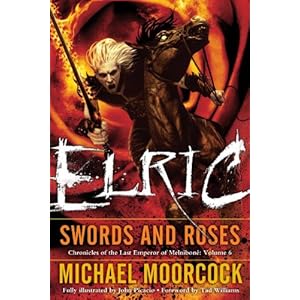
Elric: Swords and Roses
by Michael Moorcock
Cover and interior illustrations by John Picacio

Promo copy:

Feared by enemies and friends alike, Elric of Melniboné walks a lonely path among the worlds of the Multiverse. The destroyer of his cruel and ancient race, as well as its final ruler, Elric is the bearer of a destiny as dark and cursed as the vampiric sword he carries—the sentient black blade known as Stormbringer.

Del Rey is proud to present the sixth and concluding installment of its definitive omnibus editions featuring fantasy Grand Master Michael Moorcock’s most famous—or infamous—creation. Here is the full text of the novel The Revenge of the Rose, a screenplay for the novel Stormbringer, the novella Black Petals, the conclusion to Moorcock’s influential “Aspects of Fantasy” essay series and other nonfiction, and an indispensable reader’s guide by John Davey.

Sumptuously illustrated by John Picacio, with a Foreword by Tad Williams, Elric: Swords and Roses is a fitting tribute to the most unique fantasy hero of all time.

Moorcock, Picacio, and Elric! ’nuff said.

Be sure to check out this gallery of Picacio’s magnificent illustrations from Elric: Stealer of Souls (Volume One of the series).

The Iron Palace: The Shadowed Path: Book 3
by Morgan Howell
Cover by Gene Mollica

Promo copy:

BLOOD WILL TELL

Seventeen years have passed since Yim, an ex-slave blessed by the benevolent goddess Karm, sacrificed her body—and perhaps her very soul—to Lord Bahl, avatar of the evil Devourer. In that selfless act, Yim stripped Lord Bahl of his power but became pregnant with his son. Now that son, Froan, is a young man. And though Yim has raised him in the remote Grey Fens and kept him ignorant of his past, the taint of the Devourer is in his blood.

Even now an eldritch call goes out—and the slumbering shadow stirs in Froan’s blood, calling to him in a voice that cannot be denied. Armed with a dark magic he barely understands, Froan sets out to claim his destiny. When Yim seeks to stop him, her sole hope is that Honus—the love she abandoned—will take up the sword again for Karm’s sake and hers. Only then can she hope to face the impregnable bastion of unspeakable evil: the Iron Palace.

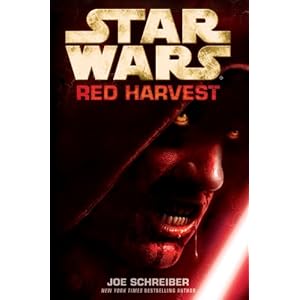
Star Wars: Red Harvest
by Joe Schreiber

Promo copy:

The era of the Old Republic is a dark and dangerous time, as Jedi Knights valiantly battle the Sith Lords and their ruthless armies. But the Sith have disturbing plans—and none more so than the fulfillment of Darth Scabrous’s fanatical dream, which is about to become nightmarish reality.

Unlike those other Jedi sidelined to the Agricultural Corps—young Jedi whose abilities have not proved up to snuff—Hestizo Trace possesses one extraordinary Force talent: a gift with plants. Suddenly her quiet existence among greenhouse and garden specimens is violently destroyed by the arrival of an emissary from Darth Scabrous. For the rare black orchid that she has nurtured and bonded with is the final ingredient in an ancient Sith formula that promises to grant Darth Scabrous his greatest desire.

But at the heart of the formula is a never-before-seen virus that’s worse than fatal—it doesn’t just kill, it transforms. Now the rotting, ravenous dead are rising, driven by a bloodthirsty hunger for all things living—and commanded by a Sith Master with an insatiable lust for power and the ultimate prize: immortality . . . no matter the cost.

Stuff received 12/11/10

Let’s take a quick look to see what’s arrived at the Geek Compound.

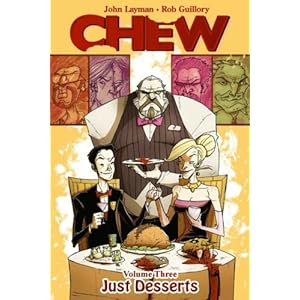
Chew Volume 3: Just Desserts
Written by John Layman
Art by Rob Guillory

Promo copy:

Things are looking up for Tony Chu, the cibopathic federal agent with the ability to get psychic impressions from the things he eats. He’s got a girlfriend. He’s got a partner he trusts. He even seems to be getting along with his jerk boss. But his ruthless ex-partner is still out there, operating outside of the law, intending to make good on his threats against Tony and everybody Tony cares about. It’s just a matter of time before their investigations collide, blood spills and, inevitably, body parts are eaten!

Chew Omnivore Edition, Volume 1 recently appeared on my Nexus Graphica top ten list.

Quote:
Layman and Guillory create an alternate present where, due to avian flu fears, the American government has criminalized the possession, sale, and consumption of all poultry! Tony Chu, investigator for the Special Crimes Division of the powerful FDA, employs his abilities as a cibopathic — he gets psychic impressions from whatever he eats — to solve crimes. Guillory’s over-the-top humorous illustrations and Layman’s clever script expertly mix to spawn an enjoyable concoction of cannibalism, conspiracy, and murder. This luscious hardcover collects issues 1-10 (Volumes 1 and 2 of the trade paperback collections), complete with character design and sketches.

My interview with Guillory will appear on RevSF sometime in January along with a chance to win the first three volumes of the Chew saga!

2010 San Francisco Giants: The Official World Series Film

Promo copy:

The Giants won their sixth World Series championship by beating the Texas Rangers four games to one in the 2010 World Series. Now you can relive the storybook triumph with the Official 2010 World Series Film on DVD and Blu-ray. It is all here! From the game-winning blasts of Edgar Renteria to the domination of Tim Lincecum: all the drama, game action, behind-the-scenes access and in-depth interviews a Giants fan could want. The Official 2010 World Series Film on Blu-Ray and DVD features an adrenaline-filled feature-length film, highlights from the entire postseason and incisive bonus features.

Greek: Chapter Five – The Complete Third Season

Promo copy:

The end of the world has come and gone. Well, Kappa Taus End of the World party, that is. And now the students of Cypress-Rhodes University face an uncertain future as a consequence of their actions. Can Rusty keep his GPA above the minimum to stay in the honors engineering program? Will Casey finally win the heart of Cappie? Can Dale make penance for his temporary lapse in morality?

The hit series Greek returns for its third outrageous season in one complete 6-disc box set! Now you can enjoy the laughs and the tears as the gang looks forward to their futures at CRU and beyond.

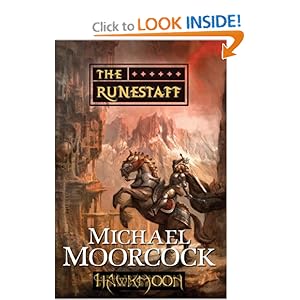
The Runestaff
by Michael Moorcock
Illustrated by Vance Kovacs

Promo copy:

In Michael Moorcock’s vast and imaginative multiverse, Law and Chaos wage war in a never-ending struggle over the fundamental rules of existence. Here, in this universe, Dorian Hawkmoon traverses a world of antique cities, scientific sorcery, and crystalline machines as he pulled unwillingly into a war that pits him against the ruthless and dominating armies of Granbretan.