MARVEL BRINGS PHILIP K DICK’S ELECTRIC ANT TO LIFE

"My universe is lying within my fingers, he realized. If I can just figure out how the damn thing works."– "The Electric Ant," Philip K. Dick

This is from PhilipKDick.com:

Quote:
The Electric Ant, Philip K. Dick’s seminal science fiction short story, will be adapted by Marvel Comics in the upcoming Electric Ant limited series to be released in 2009, it was announced by Marvel, and Electric Shepherd Productions.

[…]

The creative team behind this existential thriller includes acclaimed writer David Mack (Daredevil, Kabuki) and artist Pascal Alixe (Ultimate X-Men, 1602: Fantastik Four), joined by Consulting Editor Brian Michael Bendis (award-winning author behind Secret Invasion) and renowned artist Paul Pope, who will provide covers to the series.

About time publishers got around to publishing PKD adaptations. I imagine many more are to follow.


Pascal Alixe art

A short film version of the "Electric Ant" titled All Gates Open was produced in 2006.

Elric in the New York Times

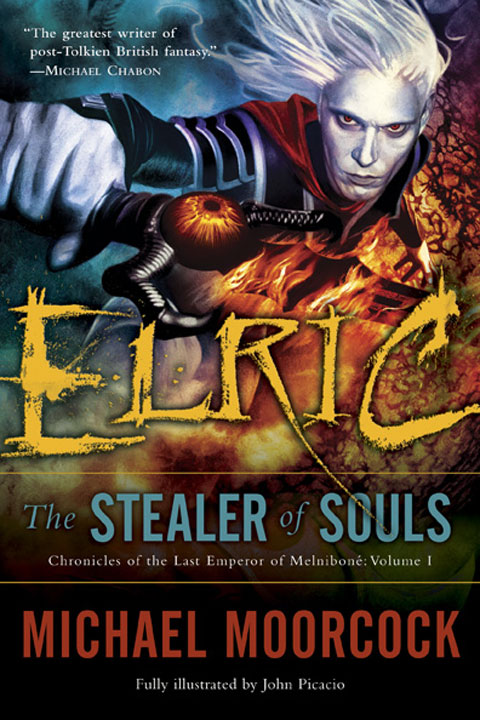
In the Sunday, July 20 New York Times, Dave Itzkoff latest Across the Universe column features Michael Moorcock’s seminal creation Elric and the recent repackaging Elric: The Stealer of Souls (Chronicles of the Last Emperor of Melniboné, Volume I).

Quote:
What is stranger still is that the world Elric was born into did not necessarily need him. Moorcock was 21 years old when he introduced the character in the June 1961 issue of a British periodical called Science Fantasy. Ray guns and rocket ships were rapidly overtaking swords and sorcery as the preferred pulp subjects of the day, and many of Moorcock’s lasting science fiction accomplishments — including his novella “Behold the Man”; his radical, satirical Jerry Cornelius novels; and his immensely influential editorship of the sci-fi magazine New Worlds — were several years away.

Three things leaped out at me from the piece.

1) Itzkoff clearly has done some reading about Moorcock and of his work. Knowing that, it’s very shocking that he writes "also C. S. Lewis and J. R. R. Tolkien — titans of fantasy who seemed to be obvious influences on him." Moorcock was influenced by the works that originally influenced the two authors as well as the writings of Mervyn Peake and Robert E. Howard.

2) What the hell is that hideous image in the article?

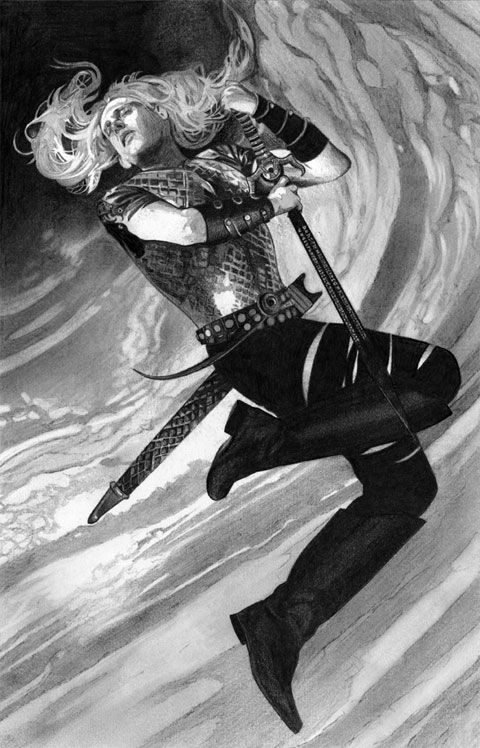
Why would any one choose that objectively inferior piece over John Picacio‘s beautiful cover or incredible interior art? (Picacio is NOT mentioned in the article.)

3) The overall poor quality of Dave Itzkoff’s writing in this piece.

I probably should stop there as both Michael Moorcock and Elric both deserve the attention and respect.

Watchmen trailer

The Watchmen trailer is out and boy is it ugly. Very sterile and everything looks computer generated. Basically, exactly as I feared.

The strength of Watchmen as a comic is that it embraces stereotypical super-hero stories and turns them on its head with some unconventional storytelling and nihilistic elements while retaining the traditional look of the genre. That is why Dave Gibbons was the perfect artistic choice. This trailer offers none of that and much like Wanted looks like your typical lets blow things up, derivative Hollywood movie.

Alan Moore interview in Entertainment Weekly!

There is a lengthy interview with Alan Moore in of all places Entertainment Weekly. Turns out The Wire and South Park are his favorite shows, we agree on the potential of The Watchmen movie, and he reveals the plot of the forthcoming League of Extraordinary Gentlemen installment.

Quote:
Whereas The League of Extraordinary Gentlemen (Vol. III): Century [the third installment of Moore’s Victorian-sleuthing comic, due out in April 2009] certainly stokes the imagination. Why make it span three different eras — 1910, 1968, and the present?
ALAN MOORE: [Artist] Kevin O’Neill and I realized we had two or three powerful stories. It struck us that we might be able to link them together and make a three-part narrative, so that each would stand on it’s own and thus relieve readers from any kind of painful cliffhanger between issues. And yet the three stories would link up into an overarching narrative involving the occult.

How do these three chapters split up?
The first book surrounds the coronation of King George, which was also the time The Threepenny Opera was set, a comet was passing overhead, and there was a general feeling of dread in the air. We’re also focusing on the occult fictions written around the time…[like] Aleister Crowley’s [1917] book, Moonchild, where the protagonists are attempting to create a magically produced child that is going to usher in a new era. [Protagonist] Mina and her associates are trying to stop this from happening. The second book [revolves around] that sort of peculiar 1960s melding of pop-star psychedelic lifestyles, fashionable interest in occultism, and to some degree, at least in London, crime. We’ve got it all centered around a big rock concert at Hyde Park. Running all the way through this is the continuing threat of the production of a magical child who, by this time, we are fairly certain, is the Antichrist. That second book ends very badly. And they’re not having a lot of luck. The third part is set in 2008 when, basically, the League is in pieces — barely exists anymore — and this turns out to be the time at which the Antichrist project finally pays off, and this magical child finally manifests in quite a terrifying form.

WOW! I can’t wait.

Batman: Gotham Knight review

My review of Batman: Gotham Knight is in the latest Austin Chronicle.

Quote:
Set between the events of Batman Begins (2005) and this summer’s The Dark Knight, Batman: Gotham Knight offers six animated visions of the Caped Crusader as envisioned by six unique animé directors and six different writers. This third original direct-to-DVD release in the DC Universe Original Animated Movies line loosely weaves the divergent pieces into a coherent storyline.

More…

I’m interviewed at Enter the Octopus

Matt Staggs interviewed me for his blog Enter the Octopus. We talked about geekdom, my grandfather, my new SF Site column, and other related topics.

Quote:
Matt: Is there a history of “geeks” of different sorts in your family?

Rick: Sort of… my uncle is a huge film geek. Matter of fact, about once a month or so, we’ll have a conversation about various monster movies. He goes to serial conventions.

My sister treats “geek” like it’s a dirty word or there is something wrong with it. I’ve taken great pride in making my nephew (her oldest son) into a geek. By the time he was five, he knew all the Godzilla monsters and the related mythos. He called me the other day and was discussing the philosopher’s stone and homonculi with me. He’s 11.

This may be the first interview I’ve ever done with no mention of gorillas or apes!

First Day The Earth Stood Still trailer

The trailer, littered with explosions and quasi-X-Files moments, shows exactly what I feared from this film. The original was a thoughtful, quiet film that successfully explored paranioa. The beautifully written and directed picture perfectly captured science fiction movies of the era. Then on second thought with explosions and overt paranoid elements, this new version may sadly capture the science fiction movies of the current era.

Lewis Shiner’s Black and White

Last year, I interviewed Lewis Shiner about his Fiction Liberation Front. Now, I’ve reviewed his latest novel, Black & White, for The Austin Chronicle.

Quote:
On the surface, Black & White demonstrates the struggles of historical and contemporary racism, but at its core, the story revolves around a son coming to terms with the sins of his father. The always-talented Shiner has produced some of his finest work to date here. Beyond a brief, discursive foray into Ruth’s story, he has created a near-perfect novel – steeped in important political and societal issues, neatly wrapped in the trimmings of a mystery story. With Black & White, Lewis Shiner ascends to a literary realm previously reserved for the likes of Michael Chabon and Jonathan Lethem.

More…