The Suddenness of Things

My Nexus Graphica co-conspirator Mark London Williams penned this moving, heartfelt appreciation of the late comic book shop pioneer Rory Root and his impact on Mark’s life and art.

Quote:
And then came Comic Relief, Rory’s store, opening up near the top of University Avenue. It was crammed with mainstream, underground, foreign and “adult” releases, and was one of the first retailing spaces to get behind those collected, bound “graphic novel” thingies that are so au courant right now.

The irony was, I had already moved down the I-5 here to the Pueblo of Angels (where, NorCal ex-pat that I am, I remain while my sons do their own growing — though I’m not convinced the water will hold out, down here, but again, another column entirely). But I return to the Bay Area’s auld sod often, and I’d pop in to Comic Relief whenever I could.

Rory was kind enough, in the early days of my Danger Boy books, to sponsor a signing for me at the San Diego Comic-Con, since the original Tricycle Press editions of the first two books featured covers by the Promethea art team of J.H. Williams III, Mick Gray, and Jeromy Cox.

I can’t say we were overwhelmed by long lines of fans, in those earliest days of the book’s release, but I always appreciated Rory’s willingness to help another Berkeley brother out, even if he was writing prose with no interior pictures.

Continued…

The Suddenness of Things was originally published on The Geek Curmudgeon

The Suddenness of Things

My Nexus Graphica co-conspirator Mark London Williams penned this moving, heartfelt appreciation of the late comic book shop pioneer Rory Root and his impact on Mark’s life and art.

Quote:
And then came Comic Relief, Rory’s store, opening up near the top of University Avenue. It was crammed with mainstream, underground, foreign and "adult" releases, and was one of the first retailing spaces to get behind those collected, bound "graphic novel" thingies that are so au courant right now.

The irony was, I had already moved down the I-5 here to the Pueblo of Angels (where, NorCal ex-pat that I am, I remain while my sons do their own growing — though I’m not convinced the water will hold out, down here, but again, another column entirely). But I return to the Bay Area’s auld sod often, and I’d pop in to Comic Relief whenever I could.

Rory was kind enough, in the early days of my Danger Boy books, to sponsor a signing for me at the San Diego Comic-Con, since the original Tricycle Press editions of the first two books featured covers by the Promethea art team of J.H. Williams III, Mick Gray, and Jeromy Cox.

I can’t say we were overwhelmed by long lines of fans, in those earliest days of the book’s release, but I always appreciated Rory’s willingness to help another Berkeley brother out, even if he was writing prose with no interior pictures.

Continued…

Build Your Own Iron Man Armor

The fine folks at the Wired How-To Wiki offer this little weekend project.

Quote:
Build Your Own ‘Iron Man’ Armor

Even if you aren’t kidnapped by terrorists and forced to work in their weapons lab like Tony Stark aka Iron Man, there are many advantages to making your own full-body suit of bullet proof armor. Walking calmly through a hail of gunfire with rounds pinging off you in all directions is a handy short cut to superhero status, and it will certainly impress your friends and colleagues. It may also be useful during disputes with neighbors, and you’ll never need to worry about what to wear to a fancy dress party again.

Quote:
When you’re putting this much work into your armor, it’s tempting to go overboard with extra gadgets you may not really need. Inventor Troy Hurtubise has equipped his home-made armor with a transponder, a recording device, emergency morphine and salt compartments and a forehead-mounted laser pointer.

Quote:
Finally, spend some time getting used to your armor before you rush out to take on the bad guys. It’s not as easy as the movies make out; wearing medieval knight’s armor has been likened to carrying sandbags and wearing boxing gloves and diving boots with a bucket over your head.

Build Your Own Iron Man Armor was originally published on The Geek Curmudgeon

Build Your Own Iron Man Armor

The fine folks at the Wired How-To Wiki offer this little weekend project.

Quote:
Build Your Own ‘Iron Man’ Armor

Even if you aren’t kidnapped by terrorists and forced to work in their weapons lab like Tony Stark aka Iron Man, there are many advantages to making your own full-body suit of bullet proof armor. Walking calmly through a hail of gunfire with rounds pinging off you in all directions is a handy short cut to superhero status, and it will certainly impress your friends and colleagues. It may also be useful during disputes with neighbors, and you’ll never need to worry about what to wear to a fancy dress party again.

Quote:
When you’re putting this much work into your armor, it’s tempting to go overboard with extra gadgets you may not really need. Inventor Troy Hurtubise has equipped his home-made armor with a transponder, a recording device, emergency morphine and salt compartments and a forehead-mounted laser pointer.

Quote:
Finally, spend some time getting used to your armor before you rush out to take on the bad guys. It’s not as easy as the movies make out; wearing medieval knight’s armor has been likened to carrying sandbags and wearing boxing gloves and diving boots with a bucket over your head.

Happy Birthday Maurice Sendak!

When people ask me about my influences, one of the names I always forget is Maurice Sendak. Sendak, who turns 80 today, and his seminal work Where the Wild Things Are, if not created my love for monsters, certainly fostered it. The tale of childhood rebellion and unconditional love fed directly into my childhood psyche and reality. My mother always encouraged me to debate, to wonder, to question. All the while, I knew she would always love me. When I began writing, the fact that my family would always love and respect me lent me the confidence to write what I felt and believed, regardless of what others thought. And of course monsters have always been a huge part of my creative reality.

Over time I read the vast majority of Sendak’s works but nothing stuck like Wild Things and for Halloween 1997, I was Max. You really have to love a children’s book to dress as the main character when you are thirty.

Thank, Mr. Sendak, for everything and a happy 80th birthday!

Happy Birthday Maurice Sendak! was originally published on The Geek Curmudgeon

Happy Birthday Maurice Sendak!

When people ask me about my influences, one of the names I always forget is Maurice Sendak. Sendak, who turns 80 today, and his seminal work Where the Wild Things Are, if not created my love for monsters, certainly fostered it. The tale of childhood rebellion and unconditional love fed directly into my childhood psyche and reality. My mother always encouraged me to debate, to wonder, to question. All the while, I knew she would always love me. When I began writing, the fact that my family would always love and respect me lent me the confidence to write what I felt and believed, regardless of what others thought. And of course monsters have always been a huge part of my creative reality.

Over time I read the vast majority of Sendak’s works but nothing stuck like Wild Things and for Halloween 1997, I was Max. You really have to love a children’s book to dress as the main character when you are thirty.

Thank, Mr. Sendak, for everything and a happy 80th birthday!

Philip K Dick Topples the American Canon

This bit comes from Media Bistro:

Quote:
When the Library of America‘s publicist informed me that last year’s collection of four classic Philip K. Dick novels was their fastest-selling title ever, I was pleasantly surprised, but I wanted some proof. LOA marketing manager Brian McCarthy was happy to oblige, informing me that the Library had shipped 23,750 copies of Four Novels of the 1960s—the better part of two complete print runs—and that returns were a “staggeringly low” 5 percent. By way of comparison, the Library’s last major foray into science fiction and fantasy, the H.P. Lovecraft Tales published in 2005, sold 11,860 copies (with a similar return rate) in its first year (with gross sales-to-date now standing at 26,000-plus.)

This is better than other more traditional LoA “heavy-hitters” such as the first collection of Jack Kerouac novels (shipped just under 15,000 copies in its first year, with a return rate of 10 percent), two-volume collection of Edmund Wilson’s critical writings (9250 and 12%) and the American Poetry: The Seventeenth and Eighteenth Centuries anthology (4200 and 8%).

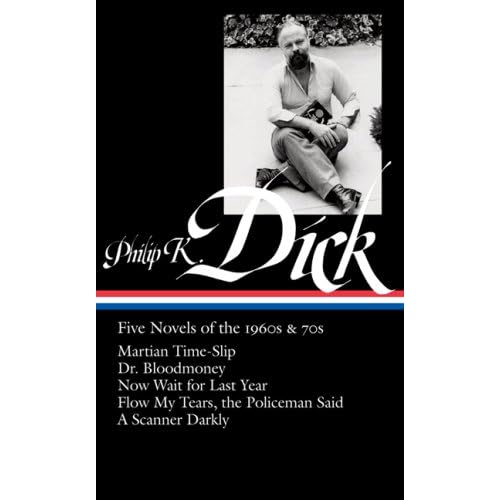
And the trend should continue with the second PKD volume (Five Novels of the 1960s and 70s which includes Martian Time-Slip, Dr. Bloodmoney, or How We Got Along After the Bomb, Now Wait for Last Year, Flow My Tears, the Policeman Said, and A Scanner Darkly). The book is not due out until July 31 and pre-orders already exceed 10,000.

It’s a good time to be a Dickhead!

Philip K Dick Topples the American Canon was originally published on The Geek Curmudgeon

Philip K Dick Topples the American Canon

This bit comes from Media Bistro:

Quote:
When the Library of America‘s publicist informed me that last year’s collection of four classic Philip K. Dick novels was their fastest-selling title ever, I was pleasantly surprised, but I wanted some proof. LOA marketing manager Brian McCarthy was happy to oblige, informing me that the Library had shipped 23,750 copies of Four Novels of the 1960s—the better part of two complete print runs—and that returns were a "staggeringly low" 5 percent. By way of comparison, the Library’s last major foray into science fiction and fantasy, the H.P. Lovecraft Tales published in 2005, sold 11,860 copies (with a similar return rate) in its first year (with gross sales-to-date now standing at 26,000-plus.)

This is better than other more traditional LoA "heavy-hitters" such as the first collection of Jack Kerouac novels (shipped just under 15,000 copies in its first year, with a return rate of 10 percent), two-volume collection of Edmund Wilson’s critical writings (9250 and 12%) and the American Poetry: The Seventeenth and Eighteenth Centuries anthology (4200 and 8%).

And the trend should continue with the second PKD volume (Five Novels of the 1960s and 70s which includes Martian Time-Slip, Dr. Bloodmoney, or How We Got Along After the Bomb, Now Wait for Last Year, Flow My Tears, the Policeman Said, and A Scanner Darkly). The book is not due out until July 31 and pre-orders already exceed 10,000.

It’s a good time to be a Dickhead!