DVDs received 10/25/10

Let’s take a quick look to see what’s arrived in the mail here at the Geek Compound.

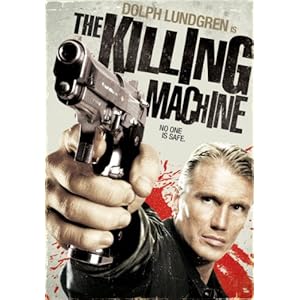
The Killing Machine

Promo copy:

If you thought he was hardcore in THE EXPENDABLES, he’s now totally unstoppable as the KILLING MACHINE: Action icon Dolph Lundgren (ROCKY IV, UNIVERSAL SOLDIER) stars as Edward Genn, a divorced Vancouver father and investment broker who also happens to be the infamous KGB-trained assassin known as Icarus . But when his two worlds collide in a storm of bullets, bloodshed and betrayal by the Russian Mob, Icarus reloads for the most personal and punishing contract of his entire career. When revenge is not enough, how far will a one-man death squad go to get even? Stefanie Von Pfetten, Samantha Ferris (SUPERNATURAL) and Bo Svenson (INGLORIOUS BASTARDS, WALKING TALL) co-star in this bone-snapping, skull-blasting, badass throwback to extreme ’80s action movies, directed by Lundgren himself!

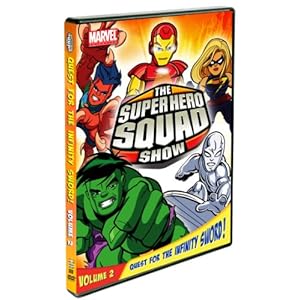
The Super Hero Squad Show: Quest For The Infinity Sword Vol. 2

Promo copy:

The greatest heroes in the world return to face its craziest villains in the second action and laugh-packed volume of the The Super Hero Squad Show! Watch as Iron Man, Wolverine, the Hulk, the Silver Surfer, Thor, the Falcon and their friends faithfully, and hysterically, protect Super Hero City from the wild, weird and even wacky villainy of VillainVilles most infamous baddies, led by the sinister Dr. Doom!

Featuring the guest voices of Kevin Michael Richardson (Family Guy), Greg Grunberg (Heroes), Wayne Knight (Seinfeld), Ray Stevenson (Punisher: War Zone), and Lena Headey (Terminator: The Sarah Connor Chronicles)!

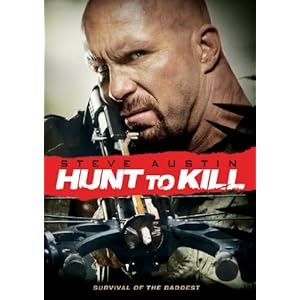
Hunt To Kill

Promo copy:

When Jim’s (STEVE AUSTIN) teenage daughter is kidnapped, he’s forced to lead a band of ruthless killers into the wilderness to retrieve their share of a missing heist score. In order to rescue his daughter, Jim must use his unique brand of survival skills to outsmart the kidnappers before it’s too late. HUNT TO KILL is an action packed adrenaline rush about a man operating on his most primal instincts to save the one thing he’s willing to die for – his daughter.

King of Terror: Conversation w/ Stuart Gordon Part 2

In 2003, I interviewed legendary horrormeister Stuart Gordon for the now defunct Science Fiction Weekly from Scifi/SyFy.com. The piece, originally edited due to length concerns, is no longer available online. 

As a Halloween treat, I’m reprinting the complete 6,000 word conversation in three easily-digestible blog entries. 

One of my more enjoyable assignments, I hope you have as much fun reading this as I did chatting with the affable Gordon. 

Stuart Gordon Interview Part 2

With Rick Klaw

Have you had anything to do with the Re-Animator sequels?

GORDON: No, I haven’t. Although I am trying to convince Brian Yunza [director of the two sequels] to do another one, which is called House of Re-Animator, and it’s about the White House.

(laughing)

(laughing) When I saw Donald Rumsfeld, when he showed up, it was sort of like, “Wait a minute, I thought this guy was dead. How did he get reanimated?” Where did these people…James Baker? All of a sudden all these people are crawling back out of their holes in the ground.


Jeffrey Combs and the head of David Gale in Re-Animator

Jeffrey Coombs is getting old enough to play the president now. You could do it.

Well, I think Jeffrey Coombs would be reanimating the uh…in our idea he’s reanimating the Vice President.

In your early career, Jeffrey Coombs was involved in a lot of your movies. He hasn’t been in your more recent features. Was there a conscious decision to kind of distance yourself, or was he busy, or..?

No, I think it just had to do with the movies themselves. There wasn’t really the right role for Jeffrey. I would love to work with him again. It’s just finding the right part.

He’s kind of like your Bruce Campbell.

Yeah, he is.

At the moment, I keep thinking of Bruce Campell as Elvis.

Oh, he was great in Bubba Ho-Tep.

In movies like Re-Animator, From Beyond, and Castle Freak, umm…you have women engage in…interesting acts, to say the least.

(laughing)

Have you had any actresses balk at doing these scenes, saying, “Okay look, this is too far. I’m not doing this?”

I’ll tell you something: Barbara Crampton was not the first actress that was cast to play that part in Re-Animator. The original actress did balk at it and said, “No, I can’t do it” even after she had read the script and we had gone through all these callbacks and so forth. When she finally got cast like a couple days later, she dropped out.
So, yeah, that has happened. And Barbara…it’s so funny, I cannot even remember the name of this first actress, you know, because Barbara was so amazing. She just kind of wiped it out of my mind.

She was great. It’s just that when you watch the movie, that’s one of the things you think of, you know: Did you have any trouble getting her to do some of this stuff?

No. Barbara’s a really brave actress, and she’s a risk-taker. That’s the kind of actress that I really love and need. The people who are willing to look foolish or do something that seems completely degenerate or something, realize that… to me, the acting is the best special effect there is. You’ve really got to have actors that will make the audience believe things are true and really happening to them. 


Barbara Crampton in one of her tamer scenes in From Beyond

In science fiction circles there are discussions about how that’s the difference between what Peter Jackson has done with his special effects and what Lucas has done with the recent Star Wars movies. The acting and the directing is so much better with Peter Jackson, the Tolkien stuff, even though they’re doing the exact same kind of digital effects, one’s so much better than the other.

You know what? You don’t need to have such great effects if the acting is good. The actors kind of do it for you, and you’ll accept something that isn’t perfect because you’ll fill in the gaps yourself. The greatest special effects in the world will not save a bad movie. 

You were influenced heavily by the Weird Tales writers, not just Lovecraft. Are there any other of those writers’ works you’d like to adapt?

I don’t know. We were talking about Robert Howard and Conan [in a pre-interview discussion], and I would love to do a Conan movie, that would be really great. That’d be fun. As a matter of fact, I came close on a project once and I’m sort of sorry that I ended up being not able to do it. So yeah, that’d be great. 

Talk about action. 

Yeah, and just sort of giving it kind of a new approach. 

What other things have influenced you?

I read…I was reading… It’s so funny, I think now that movies kind of got me reading. And I wonder if that still happens, that people see a movie and… I’m sure that Peter Jackson’s Lord of the Rings has gotten people to read the books. 

I read some where that Tolkien sales are up over 500%.

That’s great. That’s what happened to me. When I saw l the Roger Corman movies, I started reading Poe. And when I saw Time Machine, I started reading H.G. Wells. You see something and you go, “Who came up with this?” And I read Dracula as a kid, and it scared the shit out of me. 

It’s a great book.

Yeah, the book is really great. I don’t think any movie’s really captured Dracula as he’s written. I was so scared, I remember I was reading in a room in Chicago and just reading it in the middle of the summer, and it was swelteringly hot and we didn’t have air conditioning, but I was closing and locking my windows every night. I didn’t want any bats flying in. 

Yeah, I can definitely see that. It’s funny, because when I saw the name of the movie, King of the Ants, my first thought was, he filmed H. G. Wells’ Empire of the Ants, and I was like, “All right!”

Yeah, yeah, I know, I know. Everybody’s so disappointed. They’re saying, “Where are the giant ants?” But I already did giant ants, you know, I did Honey, I Shrunk The Kids.

Well yeah, but I think this would have been a little different. They would have had blue eyes.

(laughing) Yeah, that’s right. 

We were talking a little bit about the 50s and horror, and the 50s, of course was a big boom, and the 30s was a big boom with Weird Tales, the 20s and 30s. There’s a popular theory going around that horror is very popular during Republican administrations, when the president is much more conservative.

That’s interesting. I think it’s true, actually, there is something about repression and horror, and the more repressed the society you live in, the more need there is for horror movies, I think that is true. 

‘Cause we’re certainly going through it now, again.

Yeah, that’s right. 

And when you first came on the scene in the 80s we were going through it.

Yeah, that’s right, it was Reagan and now we’ve got Bush and it’s like Bush, Jr., it doesn’t get much more repressive than now. 

At the premiere you really confused me. Somebody asked you, “What are you working on now?” and you said a circus.

(laughing)

A circus?

Yeah. Well, I’m actually helping out a friend of mine, his name is Norm Langill, and he has a show running in Seattle and also in San Francisco called Teatro Zinzanni. What it is… it’s kinda hard to describe, but it’s…you’re served a five course meal by clowns, acrobats, jugglers, and magicians. It’s been a huge hit. It’s been running for almost five years in both those cities. He knows what a big fan I am of circus. We had met when I was doing theater many years ago. So he invited me to come and help him. They have a cast change going on, so I’m bringing the new cast into one of the shows. Every time the cast changes, there’s got to be a whole new story that’s created around them.

Interesting. How does that compare to doing film or even your other theater experiences, because those are a lot different?

It is, it’s very different, because you’re dealing with European performers, and most of them speak some English they come from all different countries… Russia, Vietnam, and Switzerland… it’s really kind of like the Tower of Babel trying to work with them all. Plus they’re all extremely, very highly trained. I found out that clowns get as much training, you know, in Europe, as doctors do here. You know, they go to school for years and years to become a clown.

Doctorate in Clownology?

(laughing) I know, I know. It’s really something. The clowns are actually the most highly-trained performers in a circus, and one of them told me that you really cannot be a great clown until you’re about 50 years old. I said, “Why is that?” and he said, “Because you have to live.” To really be able to, you know, sort of experience life to be able to portray it as a clown.

That sounds fascinating. So they like, serve the food and…

They do. When they start out, you think they’re waiters and stuff, and then it turns out they start doing these amazing things at your table. The first time I saw it, the guy came over and he started pointing at the silverware on the table and the silverware started moving all by itself.

Wow.

Yeah, it makes you jump. It’s a very intense show, but very much fun. It’s kind of like being in a Fellini movie, or something. It’s great.

It’s a whole new meaning to dinner theater.

It is. That’s right. He’s reinvented it.

You’ve done film, you’ve done theater, and you’ve done, well, circus now, and you’ve done TV. Is there one that you prefer over the other?

I like them all for different reasons. Theater is still the most powerful art form. Even more powerful than film, because it’s all happening there: it’s really happening in front of you, and the audience, becomes part of the creation of the artwork. With a film, it doesn’t matter if there’s people watching it or not; it will always be the same. But theater changes every night based on who’s there in the audience. It’s a real sort of two-way communication. But there’s things that you can do in movies that cannot do in theater, so I like doing all of them.

Is there something artistic that you haven’t done that you would like to do?

Yeah, I’d like to direct an opera. That would be kind of fun. That’s something I’ve never done.


Stuart Gordon during the 2007 WGA strike.

(pause) Sorry. I was just imagining your version of Phantom of the Opera.

(laughing) I love musicals, and it was funny, I was trying to get… I contacted Stephen Sondheim. I was trying to get the rights to Sweeney Todd, which I think could be really fun as a movie. For awhile there nobody was making musicals but…

Now they’re big again.

Yeah, so, it’d be fun to do one of those.

You’ve recently started producing films besides your own. How is that?

I did it a couple of years ago, and I’m going to be doing some more of it. Producing work by first time directors or, writer/directors is great. The thing that’s difficult as a producer is that you sometimes feel like you want to just get in there and do it yourself. It’s holding yourself back and not doing that that’s sort of difficult. To be in there to help the director get his vision without intruding. That’s really the key to producing.

On the other end of the spectrum, you’ve also done some screenwriting and not directed it As a director who’s often directed his own work and who has definitely put his own vision on everything, how has experience been for you?

I’ve been lucky in that it’s usually been a good experience. Although the thing about writing is that it’s very rare that you get your work done exactly as you wrote it. There’s usually somebody brought in to do a revision, or this or that, so there are changes that are made, and sometimes you like the changes, and sometimes you don’t. It can be frustrating.

I’m sure you’ve dealt with that on the other end as a director, changing what the writer has written, ‘cause you’ve directed other people’s screenplays.

Yeah, yeah. Although, I usually will not change the words without conferring with the screenwriter and getting his okay on it.

Do you find a big difference in how you work when it’s somebody else’s screenplay or your own?

Even if it’s not my own screenplay I usually work so closely with the screenwriter that I feel really close to the material. That’s really key. I think the director’s job is to bring to the screen what’s on the page. So you really have to understand why everything is there, what he’s trying to achieve with everything he writes. So when you write, when you’re involved with the writing yourself, it’s easier, in a way, because you know. But, the hardest thing is doing something from somebody like Shakespeare and you can’t just call him up and say, “Now what did you mean by this?”

(laughing) “I don’t understand this, Bill.”

(laughing) “Yeah, what’s this ‘to be or not to be’ stuff?”

Continued…

And more in Part 1.

King of Terror: Conversation w/ Stuart Gordon Part 1

In 2003, I interviewed legendary horrormeister Stuart Gordon for the now defunct Science Fiction Weekly from Scifi/SyFy.com. The piece, originally edited due to length concerns, is no longer available online.

As a Halloween treat, I’m reprinting the complete 6,000 word conversation in three easily-digestible blog entries.

One of my more enjoyable assignments, I hope you have as much fun reading this as I did chatting with the affable Gordon.

Stuart Gordon Interview

With Rick Klaw

Know for his creative uses of graphic violence, disturbing situations, and a diversity of subject material, Stuart Gordon is a legend in the low budget horror film industry. His movies Re-Animator and From Beyond influenced an entire generation of filmmakers including Lord of the Rings director Peter Jackson. While with Disney he created the popular Honey, I Shrunk the Kids and adapted Ray Bradbury’s play The Wonderful Ice Cream Suit, which he first brought to the stage as part of the groundbreaking Organic Theater Company. Science Fiction Weekly was lucky enough to catch up with Stuart Gordon at the Alamo Drafthouse for the Austin, TX premiere of his latest film, King of the Ants, to discuss Lovecraft, the state of horror, Disney, perversity, and other interesting topics.

To prepare for this interview, I watched the only two Stuart Gordon films that I hadn’t seen. They were Castle Freak and The Wonderful Ice Cream Suit, which I viewed back to back.

GORDON: (laughing)

I’ve got to tell you, I was a little confused. How do you go from being the guy who did things like Re-Animator, From Beyond and Castle Freak to Honey, I Shrunk the Kids and The Wonderful Ice Cream Suit? Most people don’t do those kinds of things.

Honey, I Shrunk the Kids is a horror movie about a mad scientist whose experiment gets out of control with disastrous results. Everyone always goes, “Well, how can you do From Beyond and Honey, I Shrunk the Kids,” and I say, “It’s really the same movie.” The story is the same.

Yeah. You take the gore out, and it’s pretty much the same story.

We had some pretty horrific…I mean, it was funny. Disney was very worried about it when we were working on it, they kept saying “We want this to be more like The Absent-Minded Professor and less like The Fly.”

(laughing)

(laughing) They didn’t go for The Fly?

I had a big argument with them about what the ants should look like in Honey, I Shrunk the Kids. They said to me, “What is this ant gonna look like?” and I said, “Well, it’s gonna look like an ant.” They said, “Isn’t that gonna scare the kids?” I said, “What do you think it should look like?” They said, “Well, we think it should have blue eyes, like, look sort of like E.T.”

Little eyelashes, maybe?

I said, “Well, E.T. scared more kids than an ant does.” Finally, it came down to, I had to take the executives to the shop that was building this giant ant puppet, and I said, “In a way, it’s good that they think it’s scary when they first see it, then it turns out that it’s not scary, it’s nice.” And when I said that, the ant, the guy that was puppeting it, had the ant come up and he put its antennae over my shoulders and sort of nuzzled me, like a horse would nuzzle somebody. Then all of a sudden it was okay. The Disney guys got it. They were very concerned about that movie.

Yeah I can see that. And with your reputation, of course, preceding you.

Yeah. And The Wonderful Ice Cream Suit I had originally directed as a play at The Organic Theater Company in 1973.

Really?

Yeah, with Joe Mantegna playing the same role that he plays in the movie. So it was kind of a return to my roots.

Right. You might be directing a David Mamet film? That’s kind of the same “going back to your roots” thing?

Yeah. Although the Mamet thing is a little more like the other movies I’ve done in that it’s a very disturbing piece. But, you know, Ray Bradbury became a good friend after we did the play, and we stayed in touch. He came up to me one day, we ran into each other on the street, and said, “What about doing The Wonderful Ice Cream Suit?” I brought him over to Disney to meet the executive who was the head of features, and Ray Bradbury wore a white suit. I thought, “We can’t lose!” We walked in and he said to the executive, “Boy, I’m so excited. The last time I was here, I had lunch with Walt.” And the executive said, “Walt’s dead.”

(laughing) Wow!

Yeah, yeah, so Ray and I are like, “What’s going on here?” Then Ray says, he’s trying to kind of smooth things over, he goes, “I want to congratulate you on the success of the animated features.” The guy goes, “You don’t have to lie to me. The only person you have to lie to is your mother.” Then Bradbury says, “Well, sometimes, you just feel like you’re in a room full of mothers.” That was the beginning and the end of the meeting right there. The guy passed on the project, and I called Ray to tell him, and he said, “Gosh, it’s really surprising, because I know that Roy Disney really likes this story and play. He’d seen the play many times.” I called Roy and I told him what had happened with the executive, and he said, “Well, come on to my office.” We go to his office and there’s the executive sitting there, and Roy says, “I think we should make this movie, don’t you?” That’s how it got made.

Soon after you returned to horror with Dagon. Do you see your career going in that direction, or are you looking to do lighter fare again or does it really matter that much to you?

I kind of like to mix it up a little bit, because I think if you do the same thing too often, you get kind of tired of it. King of the Ants is a kind of different thing for me, too.

It is a different kind of film for you. I know you’ve talked about this elsewhere before, but the people reading this interview may have never heard this story, how did King of the Ants come about?

It was really George Wendt who brought the book to me, and he said, “If you like this, I’ll option it.” I read it, and it was… I was completely shocked by this book, ‘cause, it’s the story about a guy who murders an innocent man about a third of the way through the story. I couldn’t believe that they were going to have this very likable protagonist commit murder. But he does. And somehow, you’re still with him, and that was the thing that really drew me to the story. I couldn’t figure out how the author had accomplished that.

So you hired him to do the screenplay?

Yeah. And he worked on it… I would say he worked on the screenplay for almost two years. He really did a lot of departures from the book. First of all, the book is set in London, and Charlie Higson, the writer is English, Americanized it and moved it to L.A. He really did a lot of changes, particularly in the second half, from the novel. It was a big departure. In the novel, the main character does not end up going back to the wife of the man that he murders. That was all new, specifically created for the film.

It’s interesting; because it reminded me of…have you ever read The Wasp Factory by Iain Banks? Are you familiar with that book?

No.

It’s about a little boy who has this wasp factory. He keeps this factory and he grows wasps in it. He goes out every day to predict things, and the wasps tell him that his brother, who’s a serial killer, has escaped from the insane asylum and is coming home. The whole story is him doing these depraved things to welcome his brother home. These horrible, horrendous acts. It reminded me a lot of that, and it’s interesting, because the whole tone is very similar. I don’t want to tell you more, because the end of the book is a big shock ending. It’s one of those ending where you go, “Whoa.”

It turns out he is the brother.

No, no, his brother shows up. It’s much more shocking than that. It’s one of those things where you see the end, you read it, and when you re-read it again, you see the ending coming, but you don’t catch the clues the first time.

That’s great. I’ll look for it. That sounds good.

The ending of King of the Ants definitely left it open for a sequel. Are there plans for a sequel? Did Higson write more stories?

Well, he’s written more. He’s written three other novels, but they’re not about this character. They’re all great. All of them would make great movies. But, I have talked to him about a sequel, because it would be kind of fun. We’re talking about some ideas for it. There’s still a few people left alive. Including the little girl, the daughter, which could be pretty horrifying sequence. We were even thinking on the idea that Susan could still be alive, that she’s not dead but she’s had some, brain damage so that she doesn’t remember him.

Do you want to direct more crime films?

To me, it’s all about the story. The thing I loved about this was that I never knew what was going to happen next, so if it’s a story that’s a good story, I’ll do it. It doesn’t really matter if it’s Lovecraft or, horror, or what it is, as long as it’s something that I think is going to keep people guessing and wondering and sort of on the edge of their seat.

Early in your career you were closely associated with Lovecraft. Nobody else has ever made as good or successful Lovecraft films as you. There have been many Lovecraft movies made, but you seem to be the only one who was able to pull it off.

Oh, thank you.

They’re not exactly like the original tales. You have added your own vision to them. Lovecraft fans, even though they’re such a rabid lot, almost universally love your movies. Why are you able to make good Lovecraft films when nobody else can seem to do it?

You can’t literally take something from the page and just shoot it, because, Lovecraft wrote great stories, but you have to make a movie. It’s a different medium. One time I was working on a play adaptation of a Kurt Vonnegut book called The Sirens of Titan. Kurt Vonnegut came to see it when it was in previews, and he had the best comment. He looked at me and said, “I think you have to pretend I’ve been dead for ten years.”

(laughing) No problem there with Lovecraft.

Well, yeah. What Vonnegut was saying was that we were too literal, too literally following the book, and that we have to…you have to make changes. You have to combine characters and you have to make it more visual or more action-oriented, or whatever. You have to be able to take some liberties with it to make a good adaptation. And I think that’s true with Lovecraft, too. I think you have to go for the essence of what he’s trying to do, but you can’t slavishly follow the stories. I think it’s a question of choosing the right stories, too, because some of his stories are very internal, and those would be very difficult to adapt. But the ones that I’ve picked have been more action-packed. Re-Animator is like wall-to-wall action. The short stories are just…they’re amazing. And the same is true of “The Shadow over Insmouth”, which is the basis for Dagon. It’s a chase. There’s a lot of action in it. I think that’s kind of the secret. I’ve been lucky that I’ve had Dennis Paoli to work with, and he really understands Lovecraft.

What drew you to Lovecraft and what made you interested in doing this stuff?

I always found his stories to be the creepiest stories when I was a kid. I would read him when I was a teenager, and he just…suggests so much. The idea of all of these hidden worlds, and that, I think, is really tantalizing. He has this comment where he says: “Man lives on an island of ignorance, sort of surrounded by forces that are beyond his control.” I think that’s something we all can relate to. We all feel that way a lot especially these days. So in a way, Lovecraft has become more timely as time passes and his fans are now legion. And he’s just building power.

Continued…

Books received 10/18/10

Let’s take a quick look to see what’s arrived in the mail here at the Geek Compound.

Agatha H. and the Airship City
by Phil and Kaja Foglio

Promo copy:

Adventure! Romance! Mad Science!

The Industrial Revolution has escalated into all-out warfare. It has been eighteen years since the Heterodyne Boys, benevolent adventurers and inventors, disappeared under mysterious circumstances. Today, Europe is ruled by the Sparks, dynasties of mad scientists ruling over–and terrorizing–the hapless population with their bizarre inventions and unchecked power, while the downtrodden dream of the Hetrodynes’ return.

At Transylvania Polygnostic University, a pretty, young student named Agatha Clay seems to have nothing but bad luck. Incapable of building anything that actually works, but dedicated to her studies, Agatha seems destined for a lackluster career as a minor lab assistant. But when the University is overthrown by the ruthless tyrant Baron Klaus Wulfenbach, Agatha finds herself a prisoner aboard his massive airship Castle Wulfenbach–and it begins to look like she might carry a spark of Mad Science after all.

From Phil and Kaja Foglio, creators of the Hugo, Eagle, and Eisner Award-nominated webcomic Girl Genius, comes Agatha H and the Airship City, a gaslamp fantasy filled to bursting with Adventure! Romance! and Mad Science!

While the Tom Kidd cover is nice, it strikes me as odd that they decided to not go with a Phil Foglio cover or at the very least with a similar iconic cover design.

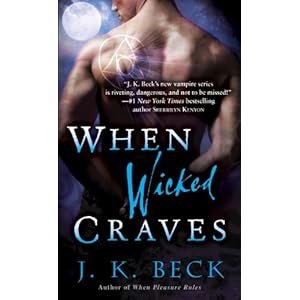
When Wicked Craves
by J. K. Beck

Promo copy:

Petra Lang is cursed never to love. One touch of her skin unleashes the vilest demons. Sentenced to death by the Shadow authorities, who fear she’ll turn her curse against them, Petra is rescued by vampire advocate Nicholas Montegue. As their bodies merge and transform into mist, Petra feels an erotic longing.

Nicholas risked his own life to save Petra, yet he knows he can never give in to the explosive attraction he feels for her. But the deep yearning they share tempts them. Together, they must find a way to lift the curse. For only a love this strong has the power to overcome such monstrous evil.

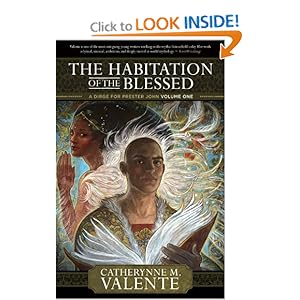
The Habitation of the Blessed
by Catherynne M. Valente

Promo copy:

This is the story of a place that never was: the kingdom of Prester John, the utopia described by an anonymous, twelfth-century document which captured the imagination of the medieval world and drove hundreds of lost souls to seek out its secrets, inspiring explorers, missionaries, and kings for centuries. But what if it were all true? What if there was such a place, and a poor, broken priest once stumbled past its borders, discovering, not a Christian paradise, but a country where everything is possible, immortality is easily had, and the Western world is nothing but a dim and distant dream?

Brother Hiob of Luzerne, on missionary work in the Himalayan wilderness on the eve of the eighteenth century, discovers a village guarding a miraculous tree whose branches sprout books instead of fruit. These strange books chronicle the history of the kingdom of Prester John, and Hiob becomes obsessed with the tales they tell. The Habitation of the Blessed recounts the fragmented narratives found within these living volumes, revealing the life of a priest named John, and his rise to power in this country of impossible richness. John’s tale weaves together with the confessions of his wife Hagia, a blemmye–a headless creature who carried her face on her chest–as well as the tender, jeweled nursery stories of Imtithal, nanny to the royal family. Hugo and World Fantasy award nominee Catherynne M. Valente reimagines the legends of Prester John in this stunning tour de force.

Books received 10/14/10 – Del Rey edition

Let’s take a quick look to see what’s arrived in the mail here at the Geek Compound.

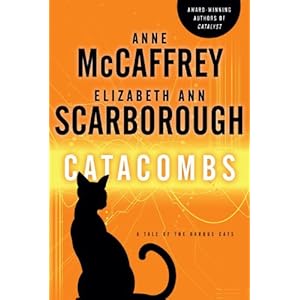
Catacombs: A Tale of the Barque Cats
by Anne McCaffrey and Elizabeth Ann Scarborough

Promo copy:

In Catalyst, award-winning authors Anne McCaffrey and Elizabeth Ann Scarborough introduced readers to the beguiling Barque Cats: spacefaring felines who serve aboard starships as full-fledged members of the crew. Highly evolved, the cats share an almost telepathic bond with their minders, or Cat Persons—until, suddenly, there is no “almost” about it, and a particular Barque Cat, Chester, learns to exchange thoughts with his human friend, Jubal. Other cats soon gain the same ability.

Behind the seeming miracle is a mysterious cat named Pshaw-Ra, who possesses knowledge and technology far beyond anything the Barque Cats—or their humans—have ever seen. When fear of a virulent plague leads the government first to quarantine and then to kill all animals suspected of infection, Pshaw-Ra—with the help of Chester, Jubal, and the crew of the starship Ranzo—activates a “mousehole” in space that carries the refugees to a place of safety: Pshaw-Ra’s home planet of Mau, where godlike cats are worshiped by human slaves.

But Pshaw-Ra’s actions are less noble than they appear. The scheming cat plans to mate the Barque Cats with his own feline stock, creating a hybrid race of superior cats—a race destined to conquer the universe. Yet right from the start, his plans go awry.

For one thing, there’s a new queen on Mau: Pshaw-Ra’s daughter Nefure, a spoiled brat—er, cat—with a temper as short as her attention span. Pshaw-Ra’s other daughter, the rightful queen Renpet, is exiled, running for her life in the only direction available to her—down into the vast catacombs beneath the Mauan desert. Far from receiving the hero’s welcome he expected, Pshaw-Ra must use every bit of his considerable cleverness just to survive.

Meanwhile, as usual, Chester and Jubal stumble right into the middle of things, in the process uncovering the lost secrets of the Mauan civilization. But that’s not all they uncover. In the forgotten catacombs deep below the Mauan capital, something has awakened. Something as old as the universe. Something that hungers to devour all light and life—and that bears an undying hatred for cats.

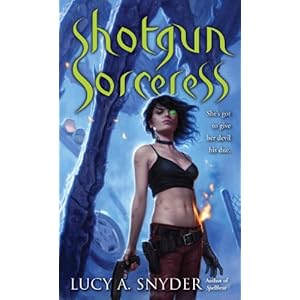
Shotgun Sorceress
by Lucy A. Snyder

Promo copy:

BURNING DOWN THE HOUSE

For Jessie Shimmer, everything changed when she went to hell and back to save her lover, Cooper Marron. After tangling with supernatural forces and killing an untouchable spirit lord, Jessie finds herself gifted—or perhaps cursed—with dark powers. And when she and Cooper make love, her pleasure throes light the whole house on fire. What is a sorceress to do?

Jessie is about to find out. The circumstances of her birth, the mystery of a father she never knew, and the help of a cuddly ferret turned fearsome monster have made Jessie not just an outlaw from mundane society, but an accidental revolutionary in the magic realm. Encountering portals stitched into thin air and a fiercely sexy soul harvester, Jessie rushes headlong among enemies, horrors, wonders, and lovers into a place of self-discovery—or destruction.

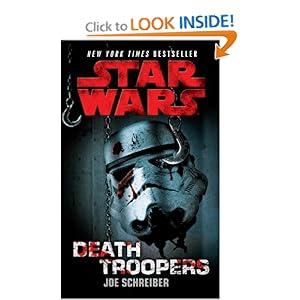
Star Wars: Death Troopers
by Joe Schreiber

Promo copy:

When the Imperial prison barge Purge—temporary home to five hundred of the galaxy’s most ruthless killers, rebels, scoundrels, and thieves—breaks down in a distant part of space, its only hope appears to lie with a Star Destroyer found drifting and seemingly abandoned. But when a boarding party from the Purge is sent to scavenge for parts, only half of them come back—bringing with them a horrific disease so lethal that within hours nearly all aboard the Purge die in ways too hideous to imagine.

And death is only the beginning.

The Purge’s half-dozen survivors will do whatever it takes to stay alive. But nothing can prepare them for what lies waiting aboard the Star Destroyer. For the dead are rising: soulless, unstoppable, and unspeakably hungry.

Star Wars and zombies?!?!

The Perfect Short Fiction Anthology

I participated in my first Mind Meld for SF Signal. With the Mind Melds, a question is posited to a variety of speculative fiction pros–writers, artists, critics and the like–and their answers are posted on the site. The topic for my first one:

Q: If you could publish a short fiction anthology containing up to 25 previously-published sf/f/h stories, which stories would it include and why?

Since only one anthology of ape fiction exists (The Rivals of King Kong ed Michel Parry Corgi, 1978) and given my proclivity for apes, I chose to compile my ultimate ape fiction anthology.

I included tales by Edgar Allan Poe, Robert E. Howard, Howard Waldrop, Joe R. Lansdale, Gustave Flaubert, V. S. Pritchett, Pat Murphy, Grant Morrison, J. G. Ballard, Italo Calvino, Arthur C. Clarke, Clark Ashton Smith, Philip Jose Farmer, Robert Bloch, Franz Kafka, and others.

Other contributors to this intriguing Mind Meld included Nancy Kress, A.M. Dellamonica, Scott A. Cupp, Steven H Silver, John Sanford, Kelley Eskridge, and Sanford Allen.

Check out the whole shebang over at SF Signal.

Elvis Can’t Salvage Yahtzee

Even the King of Rock and Roll can’t elevate the inane dice rolling game out of the halls of lame-assery.

Though it hasn’t stopped USAopoly, makers of countless improbably licensed versions of Monopoly, Risk, Clue, and other classic games, from producing two different colored sets of the Elvis Yahtzee: black and blue, each with a unique design.

No matter how cool Elvis may be, Yahtzee still stinks.

Graphic novels received 10/6/10

Let’s take a quick look to see what’s arrived in the mail here at the Geek Compound.

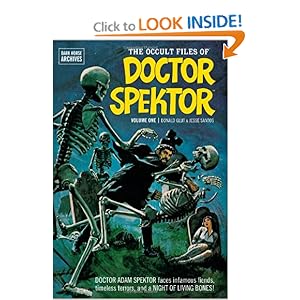
The Occult Files of Doctor Spektor Archives Volume 1
Written by Donald Glut
Art by Jesse Santos and Dan Spiegle

Promo copy:

First appearing in 1972, the adventurous and wily Doctor Adam Spektor is an occult detective and monster hunter who travels the world over in search of the supernatural, aided by a Native American assistant, Lakota Rainflower. Investigating everything from rumors of odd, ghostly occurrences to appearances of strange, deadly creatures, Doctor Spektor spends his time in the field putting his life at risk to save innocents from the sinister and the grotesque. Whether conducting occult experiments on curing vampirism or fighting unearthly behemoths, Doctor Spektor stalks the forces of evil – to record and investigate their existence as well as protect us! As artist Santos said in a 1975 interview, "When you’re dealing with dead warriors and monstrous demons… let me tell you, you’ve got to think weird!" Created by writer Donald Glut and artist Dan Spiegle, The Occult Files of Doctor Spektor are the chronicles of a strange protector – a character who often breaks the fabled "fourth wall" to address readers directly and narrate a terrifying tale from his impressive files.

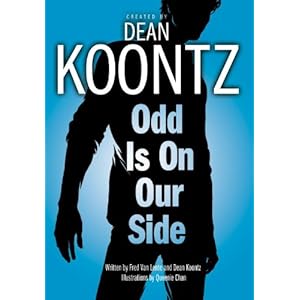
Odd Is on Our Side
Written by Dean Koontz & Fred Van Lente
Art by Queenie Chan

Promo copy:

When things get scary, it’s nice to know that Odd is on our side.

The one and only Odd Thomas is back—in his second edgy and enthralling graphic-novel adventure from #1 New York Times bestselling suspense master Dean Koontz.

It’s Halloween in Pico Mundo, California, and there’s a whiff of something wicked in the autumn air. While the town prepares for its annual festivities, young fry cook Odd Thomas can’t shake the feeling that make-believe goblins and ghouls aren’t the only things on the prowl. And he should know, since he can see what others cannot: the spirits of the restless dead. But even his frequent visitor, the specter of Elvis Presley, can’t seem to point Odd in the right direction.

With the help of his gun-toting girlfriend, Stormy, Odd is out to uncover the terrible truth. Is something sinister afoot in the remote barn guarded by devilish masked men? Has All Hallows Eve mischief taken a malevolent turn? Or is the pleading ghost of a trick-or-treater a frightening omen of doom?

Ryder of the Storm Issue 1
Written by David Hine
Art by Wayne Nichols

Promo copy:

Ryder on the Storm follows Ryder, a private eye hired by the beautiful femme fatale Katrina Petruska to investigate the horrifically bizarre suicide of her lover, Michael Hudson. Ryder’s journey to solve the case and finish Hudson’s work leads him to discover a truth more sinister and terrifying than he could ever have imagined – daemons walk among us. Now, he must team up with the last daemon hunter, Charles Monk, to take down the cabal of ancient evil controlling the city while struggling to reconcile the dark side of his own nature.

Books received 10/6/10

Let’s take a quick look to see what’s arrived in the mail here at the Geek Compound.

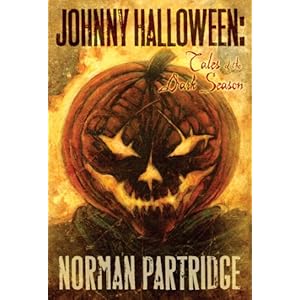
Johnny Halloween: Tales of the Dark Season
by Norman Partridge

Promo copy:

Norman Partridge’s Halloween novel, Dark Harvest, was chosen as one of Publishers Weekly‘s 100 Best Books of 2006. A Bram Stoker Award winner and World Fantasy nominee, Partridge’s rapid-fire tale of a small town trapped by its own shadows welcomed a wholly original creation, the October Boy, earning the author comparisons to Stephen King, Ray Bradbury, and Shirley Jackson.

Now Partridge revisits Halloween with a collection featuring a half-dozen stories celebrating frights both past and present. In “The Jack o’ Lantern,” a brand new Dark Harvest novelette, the October Boy races against a remorseless döppelganger bent on carving a deadly path through the town’s annual ritual of death and rebirth. “Johnny Halloween” features a sheriff battling both a walking ghost and his own haunted conscience. In “Three Doors,” a scarred war hero hunts his past with the help of a magic prosthetic hand, while “Satan’s Army” is a real Partridge rarity previously available only in a long sold-out lettered edition from another press.

But there’s more to this holiday celebration besides fiction. “The Man Who Killed Halloween” is an extensive essay about growing up during the late sixties in the town where the Zodiac Killer began his murderous spree. In an introduction that explores monsters both fictional and real, Partridge recalls what it was like to live in a community menaced by a serial killer and examines how the Zodiac’s reign of terror shaped him as a writer.

Halloween night awaits. Join a master storyteller as he explores the layers of darkness that separate all-too-human evil from the supernatural. Let Norman Partridge lead you on seven journeys through the most dangerous night of the year, where no one is safe…and everyone is suspect.

I’ve long been a Norman Partridge fan. I reviewed the above referenced Dark Harvest, declaring that "[it] thrills with staccato scenes of action, ideal for a horror novel. Using a quick, lean prose reminiscent of the finest Gold Medal-era fiction and, at the same time, as fresh as a Quentin Tarantino film, Partridge packs more into this slim volume than most authors do in a bloated 600-page epic."

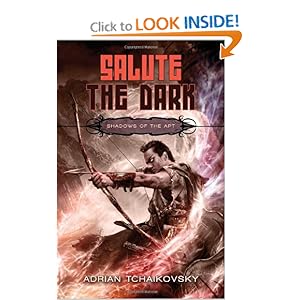
Salute the Dark (Shadows of the Apt, Book 4)
by Adrian Tchaikovsky

Promo copy:

The vampiric sorcerer Uctebri has at last got his hands on the Shadow Box and can finally begin his dark ritual–a ritual that the Wasp-kinden Emperor believes will grant him immortality–but Uctebri has his own plans for both the Emperor and the Empire.
The massed Wasp armies are on the march, and the spymaster Stenwold must see which of his allies will stand now that the war has finally arrived. This time the Empire will not stop until a black and gold flag waves over Stenwold’s own home city of Collegium.

Tisamon the Weaponsmaster is faced with a terrible choice: a path that could lead him to abandon his friends and his daughter, to face degradation and loss, that might possibly bring him before the Wasp Emperor with a blade in his hand–but is he being driven by Mantis-kinden honor, or manipulated by something more sinister?

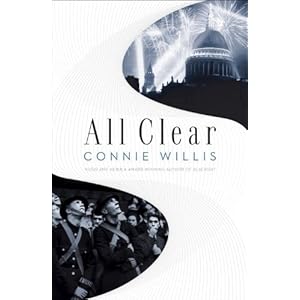
All Clear
by Connie Willis

Promo copy:

In Blackout, award-winning author Connie Willis returned to the time-traveling future of 2060—the setting for several of her most celebrated works—and sent three Oxford historians to World War II England: Michael Davies, intent on observing heroism during the Miracle of Dunkirk; Merope Ward, studying children evacuated from London; and Polly Churchill, posing as a shopgirl in the middle of the Blitz. But when the three become unexpectedly trapped in 1940, they struggle not only to find their way home but to survive as Hitler’s bombers attempt to pummel London into submission.

Now the situation has grown even more dire. Small discrepancies in the historical record seem to indicate that one or all of them have somehow affected the past, changing the outcome of the war. The belief that the past can be observed but never altered has always been a core belief of time-travel theory—but suddenly it seems that the theory is horribly, tragically wrong.

Meanwhile, in 2060 Oxford, the historians’ supervisor, Mr. Dunworthy, and seventeen-year-old Colin Templer, who nurses a powerful crush on Polly, are engaged in a frantic and seemingly impossible struggle of their own—to find three missing needles in the haystack of history.

Told with compassion, humor, and an artistry both uplifting and devastating, All Clear is more than just the triumphant culmination of the adventure that began with Blackout. It’s Connie Willis’s most humane, heartfelt novel yet—a clear-eyed celebration of faith, love, and the quiet, ordinary acts of heroism and sacrifice too often overlooked by history.

RevSF Books Editor wrote this about Blackout and All Clear:

Quote:
Despite its cliffhanger of an ending, Blackout is an engaging and suspenseful read. I have no doubt that when All Clear is released, Willis will give us a satisfying ending.

Munday’s Abundance of Riches

For the fine folks over at Moving Pictures, I interviewed Barry Munday director Chris D’Arienzo and stars Patrick Wilson and Judy Greer.

Quote:
“Barry Munday” opens with the eponymous title character, as portrayed by Patrick Wilson, lying dazed in a hospital bed shortly after losing his testicles. Earlier that day, while sitting in a theater with a young woman of questionable legal age, a strange man, whom she identifies as Dad, viciously attacks Barry with a trumpet, ultimately leading to the opening event. Shortly afterward, Barry receives notice of a paternity suit. A one-night-stand that Barry fails to remember, Ginger, played by Judy Greer, at first wants little to do with him beyond acknowledgement of responsibility. But Barry, affected by his recent physical alteration, desires to be involved with Ginger and their unborn child. He soon meets her high-brow, dysfunctional parents (Cybill Shepherd and Malcolm McDowell) and her younger, temptress sister Jennifer (Chloë Sevigny). Barry’s clinging mother (Jean Smart), psychotic ex-girlfriend (Missy Pyle), and cooler-than-thou boss (Billy Dee Williams) further enhance the excellent ensemble.

Quote:
Basing “Barry Munday” on Frank Turner Holon’s novel “Life Is a Strange Place,” director and screenwriter Chris D’Arienzo first encountered the little-known book when his agent, who also represents Holon, sent him a copy. “He thought I would dig it and said that if it was something I wanted to write that I could go off and try to tackle it. It was incredibly generous and I loved the novel immediately … the characters were so rich.”


Quote:
“[Barry’s] style is stuck around 1990,” expounds Wilson, “It was a very specific time when The Limited Express, which is a very popular women’s clothing store, started [the men’s store] Structure. Why do I know this? Because I hung out in the mall. Barry should have had stock in Structure. He bought a lot of paisley polo and rugby shirts there. And that’s kind of when he rocked.”

Quote:
The veteran actors often awed Greer. “We’re all together hanging out in this apartment complex in the Valley. Everyone’s sitting around the pool chilling out in their director’s chairs. Patrick Wilson. Chloë Sevigny. Malcolm McDowell. Jean Smart. Cybill Shepherd. It was all too much. And Billy Dee Williams. Are you kidding me?”

At the pool, Greer, who experimented with blurry photography, snapped several pictures. “My eyesight is really bad. I wear contact lenses. I had this phase of wanting to photograph things the way I saw them when I didn’t have my contacts in. Now I look back on them: ‘Really, Judy, you couldn’t take one that was in focus?’”

Read more of my discussion with D’Arienzo, Wilson, and Greer at Moving Pictures.