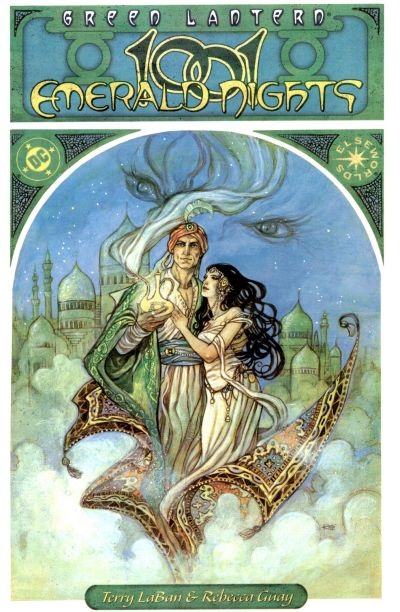
Green Lantern: 1001 Emerald Nights (2001)

“Reign of terror? I’m not sure I understand. But you’ve got lots of time to explain it to me. Well, at least the night.”

This prestige format one-shot from DC is part of their Elseworlds series where a twist is applied to a familiar hero usually by changing their normal setting. This mash up of Green Lantern with 1001 Nights was written by Terry LaBan who is more of an underground comic writer/artist but has done some work for major companies including The Dreaming for Vertigo and a Grendel mini-series for Dark Horse. The art was by Rebecca Guay whose work I know from the Black Orchid ongoing series from the 90s and some Sandman spin-offs.

In this story, Scheherazade is a Green Lantern has come to the town of Isafakhar to end the reign of the wicked sultan Ibn Rayner. But once she insinuates her way into the Sultan’s chambers, she finds that he is not the cruel ruler that she was expecting but more of a naive, misled puppet ruler. Through three tales of the reluctant hero Al Jhor Dan and his powerful genie, she tries to educate him in how a ruler show behave personally and towards his people.

A not bad story transposing the Green Lantern mythos onto the tales of the Arabian Nights. As usual with these Elseworlds tales, a lot of the elements of the superhero remain the same just subtly tweaked to fit with the new setting. So in this case the Lanterns do not have rings to start with but summon genies from lamps to carry out their will instead. Perhaps the story was a little over-moralistic but that is the nature of the originals I can live with it. Rebecca Guay’s art is perfect for this tale as she specialises in fantasy illustration and it looks great on the page – especially the leading ladies.

Camelot 3000 (1988)

“But no need to stand on ceremony. You may call me King Arthur!”

This book is a collection of the first comic book maxi-series, as claimed in the introduction by Don and Maggie Thompson. The series was written by Mike W. Barr who is probably best known for his writing on various Batman titles such as Batman and the Outsiders, the Year Two story in Detective Comics and the Son of the Demon graphic novel. The art was by British artist Brian Bolland who is more often associated, these days, with fabulous cover art but also worked on early Judge Dredd stories for 2000AD and DC’s The Killing Joke.

It is the year 3000 and Britain is under attack by relentless aliens from the solar system’s tenth planet. In it’s hour of need, King Arthur, it’s greatest defender, is reborn. His first act is to restore Merlin to his side followed by the reincarnations of his knights of the Round Table. They discover that Morgan le Fay is behind the alien attacks and so old conflicts are renewed.

I bought this book because it is one of the few examples of a comic series illustrated by Bolland whose work I love. Unfortunately the story did not match my expectations. For a comic that was DC’s first for mature readers, it felt very immature – let’s mix Arthurian legend with the future and an alien invasion and it’ll be cool. It seemed very thin and being stretched over twelve issues did not help. This book has not aged as well as some of it’s contemporaries from the mid eighties. It doesn’t help that a number of later comics, such as Fables, deal with the updating of mythological or fantasy characters much better.

But I came for the art and the art was good but it didn’t blow me away in the same way that his covers can do. Partly this is because it does not have the same detail as his work in black and white does – Bryan Talbot is another good example of someone whose work I prefer in black and white because so much more goes into it. I was also expecting more due to the problems that I know plagued this book as regards to deadlines however I don’t feel that it necessarily shows in the finished page. So all in all a bit of a disappointment – maybe you had to be there to appreciate it.

Escape Clause

I fancy myself a writer. Not that I’ve written a lot of fiction, at least on paper. I’ve created characters, stories and worlds for my gaming group, and have other stories knocking around in my skull that I need to write, which I haven’t done as I have self-confidence issues when it comes to writing fiction. In that I think most of what I’ve tried to write sucks.

I have also created many characters for my MMORPG of choice, City of Heroes, which I have been playing since the beta. That’s eight years of characters and story-lines that I’ve played out with my friends that I have made there. I love this game, and could play it forever.

Sadly, the company that runs the game shut it down tonight. No one’s sure why, as the game seems to still be making a profit. There’s a huge effort being put forth by the CoH community to save the game, and I hope that it’s successful, in that either the game’s owners change their minds, or let someone else take over the servers. But it’s a long-shot.

As I’ve thought about this game coming to a close, I’ve thought about all the characters I’ve created, and what their reactions would be to this event. The end of their multiverse. And I’ve thought of transplanting a few to other MMORPGS. Or other games in general. This got me to pondering how characters in CoH would view these other game worlds.

So let me present a piece of useless fiction (useless in that I can’t publish it) from the POV of one of my characters. I hope you enjoy it.

Continue reading

Ctrl+Alt+Del

I’ve really been terrified to do this particular comic for the longest time due to its reputation, but now that it’s over, I feel I should give it a eulogy.

Title: Ctrl+Alt+Del
Author: Tim Buckley
Start Date: 2002
Genre: Gaming
Update Schedule: Complete (a reboot is underway)
Website: http://www.cad-comic.com

Synopsis:

Ctrl+Alt+Del can be defined as two different types of comic. The first is a standard gag-a-day strip where a bunch of roommates play video games. The other involves these same characters–best friends Ethan and Lucas, Ethan’s girlfriend Lilah, and their robot Zeke–who deal with everyday situations in their lives, including relationships, jobs, and the occasional adventure.

Recommended Age Group: 15 and up, due to cursing and violence.

Strengths:

What makes CAD stand out among most gaming webcomics is that it has one characteristic that others lack: a story. Gaming webcomics are generally not designed to have storylines due to their overly comical nature; they usually make referential humor and little else. As much as the comic has been overly divisive (see the Weaknesses, because we’ve got a LOT to cover!), I can at least give Buckley credit for adding variety to a rather stale genre.

Unfortunately, just having one unique trait doesn’t make up for its many, MANY shortcomings…

Weaknesses:

Tim Buckley loves to copy and paste.
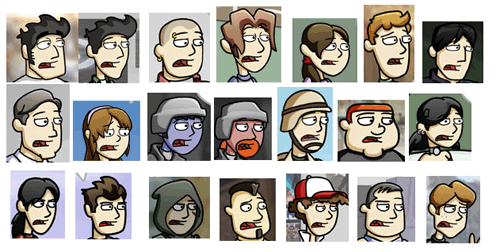
Every single character has the same face. He uses Google Images for backgrounds and adds a Gaussian blur. Lighting and shading are inconsistent. Simply put, Buckley’s talents as an artist are notably limited.

The characters aren’t well-defined, either. Ethan has been criticized for being a Mary Sue. He’s a constant jerk and he gets away with every stupid thing he does. Even worse, he winds up with all the rewards in the comic. He becomes married to the girl of his dreams, despite not showing his affections for her. He manages to construct two sentient robots that perfectly mimic life. He creates his own holiday and a church for it. He easily outwits all his opponents and winds up owning a gaming shop despite having no business experience. Finally, the characters have to apologize to HIM for all the wrongdoing that HE caused.

Remember how I mentioned that CAD is divided into two comics in the synopsis? They tend to clash constantly, interrupting the storylines with abrupt comedy and killing the tension once the drama reaches its peak.

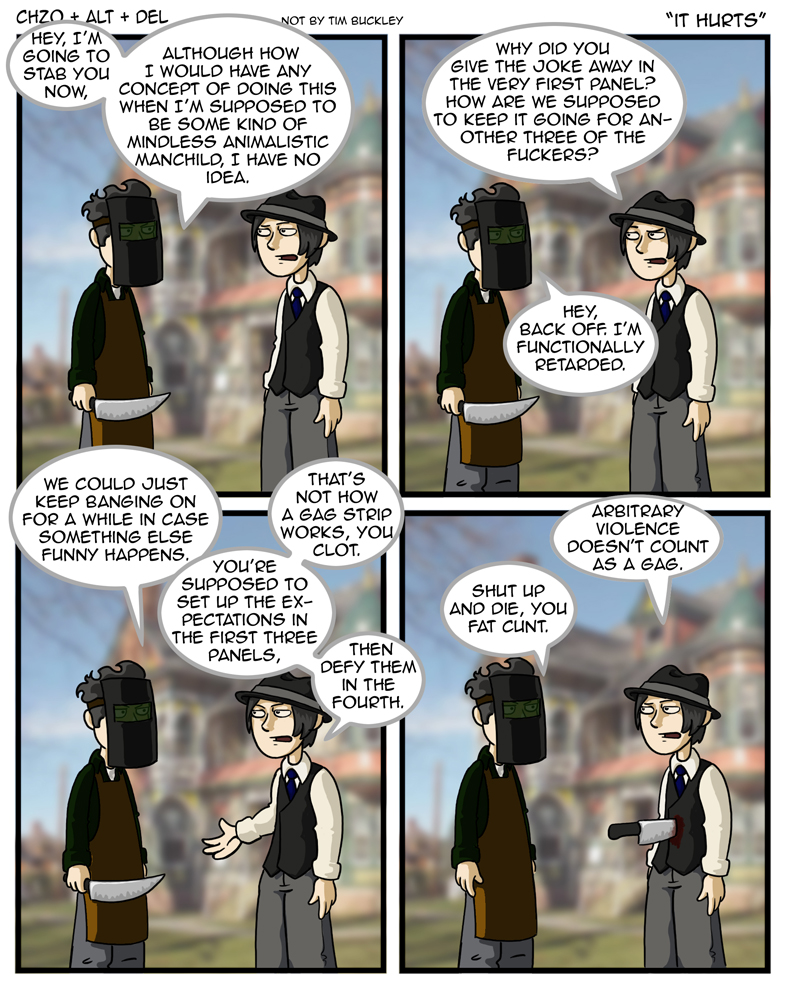
The humorous comics aren’t structured well, either. A common complaint of the comic is that the punchline is revealed too early, leaving the rest of the panels as meandering filler. This tongue-in-cheek parody of the comic exemplifies this particular issue with the strips.

The comic also breaks the show-don’t-tell rule constantly, relying on long dialogue balloons and walls of text to get the point across (comically or dramatically) rather than allowing the characters to express their emotions.

Verdict:

I give this comic a halfhearted recommendation, if only a rather faint one. Despite all my criticisms, I don’t think it’s as nail-bitingly awful as other webcomics on the Internet. The comic still has a large fanbase, and if you’ve never read it, you could probably give it a quick read and determine for yourself whether or not you would like it. It’s over, so it definitely wouldn’t hurt.

Personally, I used to read this comic many years ago when I was developing my reading habits for webcomics. I enjoyed it during its early days, but then I grew out of it when the flaws started to become more apparent. And they just continued to worsen. I stopped reading around the time the animated series came out (yes, there was an animated series, and it’s best left forgotten).

I wish Buckley best of luck on the reboot. I don’t think I’ll be tuning in, though.

Rayguns over Texas UPDATE

Design by Sara Felix


As the followers of my Twitter and Google+ feeds know, I’ve been hard at work on a new anthology. Rayguns Over Texas, an anthology of original science fiction by TX authors, is scheduled for release at LoneStarCon 3 (aka the 2013 Science Fiction Worldcon in San Antonio, TX). This will be the first major collection of original science fiction by Texas authors since the legendary Lone Star Universe (1976).

Currently the volume consists of seven stories. The final book should feature approximately 20 tales.

  • “Defenders of Beeman County” by Aaron Allston
  • “TimeOut” by Neal Barret, Jr.
  • “Babylon Moon” by Matthew Bey
  • “La Bamba Boulevard” by Bradley Denton
  • “Grey Goo and You” by Derek Austin Johnson
  • “The Nostalgia Differential” by Michael Moorcock
  • “Avoiding the Cold War” by Josh Rountree


Expect many more announcements/updates over the coming weeks.

Getting ready

So I have spent a little time doing some research on Constantine’s appearances in DC/Vertigo comics and I came across the Ultimate Hellblazer Index by John Goodrich. John has constructed a timeline of John’s career rather than his appearances (though for a lot of it is the same thing). He has pulled in a lot of appearances in other books that I was unaware of as well.

I am going to use an adapted version of this timeline to guide my reading – one that sticks more closely to publication date rather than Constantine’s personal chronology and will ignore one-off appearances in books I do not own. So I have constructed a list of comics that will start me on the Hellblazer re-read and will cover the first 100 issues of the series with some diversions along the way. The initial list is:

  • Swamp Thing 37-40
  • Swamp Thing 44-50
  • Swamp Thing 51
  • Swamp Thing 55
  • Swamp Thing 65-67
  • Hellblazer 1-5
  • Swamp Thing 70-73
  • Hellblazer 6-7
  • Swamp Thing 74
  • Hellblazer 8-9
  • Swamp Thing 76
  • Hellblazer 10
  • Swamp Thing 77
  • Hellblazer 11-24
  • Sandman 3
  • Swamp Thing 84, 88-90
  • Hellblazer 25-33
  • Swamp Thing 99
  • Hellblazer 34-40
  • Books of Magic 1-4
  • Hellblazer 41-48
  • Swamp Thing 114-115
  • Hellblazer 48-71
  • Hellblazer Special 1
  • Hellblazer 72-75
  • Swamp Thing 134-138
  • Hellblazer 76-83
  • The Horrorist 1-2
  • Hellblazer 84-100


The Joker’s Last Laugh #1-6 (2001)

“Didn’t figure you for the prayin’ type, boss.”

“Why? Because I kill people and do really rotten things to puppies and kittens?”

My first digital comics read on my new tablet is this six part series from DC. The series writers were Chuck Dixon and Scott Beatty. There were numerous artists on the series: Pete Woods; Andrew Pepoy; Marcos Martin; Mark Farmer; Alvaro Lopez; Walter McDaniel; Andy Kuhn; Ron Randall; Rick Burchett; Mark Lipka; Dan Davis.

While incarcerated at the Slabside Penitentiary, the Joker is diagnosed with a terminal brain tumour. He reacts by inciting a riot and using the prison’s own defences to “jokerize” the other inmates – may of whom are super-villains. Having created his own super-army, the Joker escapes and lets them loose upon the world hoping that he will be killed by an old friend before he dies.

The annoying thing about this series is that it is not self contained. And for a series featuring the Joker there is not nearly enough scenes in which he appears. The chaos caused by the Joker ripples throughout the DC Universe and some of the action takes place in other comics. This would be fine if the main series told its own story consistently but instead there are scene and plot changes between issues that are just not explained and so the story has unsatisfying holes in it. This is the reason I tend to avoid crossover events, and don’t read too many modern Marvel books where there constantly seems to a crossover happening. I hate the presumption of publishers that either readers are reading all their books or that they will stump up the extra to follow the story beyond a central series.

As I have already stated, the story is less a story about the Joker than it is about the victims of his cruelty. Oracle and Nightwing are the ones to suffer most throughout the story. Their moral stance on the Joker and his continued existence testing them and their relationship to the limit. This could have been a great story in the vein of The Killing Joke or A Death in the Family if it had been allowed to develop within its own pages with a consistent art team but the disjointed nature of the series ruins its emotional impact for me.

As I said at the start, this is my experience of digital comics and using a tablet to read them. In general my experience has been positive. I bought a 10″ Samsung tablet and the size of the visible screen is only slightly smaller than a standard comic page – which is important as I don’t like the directed zoom way of reading comics that can divorce the words from the images. A big plus is the regular sales on Comixology and Dark Horse Digital and, as there is a lot of old stuff I have still to pick up, I can wait for issues to be bundled or sold for 99 cents an issue. For example, the collection for this series is out of print and  I picked it up for $5.94 rather than the $30 which is the cheapest second hand copy on Amazon UK or Abe Books (once shipping is included). The only downside is the price of new comics that tend to be same price as the print version which has never seemed right to me for any digital media.

He Ain’t No Judas: My Conversation with Walter Simonson

For my latest Nexus Graphica column over at SF Site, I was lucky enough to interview the legendary Walter Simonson about his new graphic novel The Judas Coin as well as other things artistic.

What was the impetus for The Judas Coin?

Back when I was working on Michael Moorcock’s Elric: The Making of a Sorcerer, Mark Chiarello at DC approached me and asked me about contributing to a new comic he was going to be editing for DC. It was called SOLO. Each issue was going to be written and drawn by a single writer/artist. The book was to be a 44 page comic of short stories, at least one of which was to be about a DC character. Otherwise, it was wide open. I was delighted to be asked. I started thinking about what I might do, and eventually had the idea for an anthology of short stories, threaded together by one of the coins Judas was paid to betray Christ. I worked out the plots for each of the stories, but in the end, the Elric book took me longer to do than I’d thought — no surprise there — and by the time I’d completed it, SOLO had run 12 issues and was done. I still liked my idea for the comic, so I spoke to Dan Didio at DC about the anthology. He liked the idea, and suggested I find an editor and write up a proposal for a 96-page hardcover. That worked out, but Mark was the guy whose initial approach sparked the book.

Check out the entire interview over at SF Site.


Thor #337  Alien: The Illustrated Story Elric: The Making of a Sorcerer Thor as a frog